In the 273rd live broadcast room, a netizen asked: What die steel is suitable for stamping 4mm thick stainless steel? Stamping 4mm stainless steel involves a typical thick and hard material stamping process, given the hard and thick material.
Based on past customer feedback, the primary failure mode of molds is cracking. When selecting die steel, priority should be given to resistance to cracking, rather than wear resistance. Your consideration of wear resistance is unnecessary, as the mold breaks before it reaches the level of wear. Your consideration of wear resistance is redundant and futile. Instead, priority should be given to resistance to cracking. As long as the resistance to cracking is addressed, the mold’s service life will be extended.

Mr. Li from Dalang, Dongguan, is punching four 6.8*6.8mm square holes on 4mm thick 201 stainless steel. They originally used DC53 punches, but they could only punch 800-1000 products before the punches would break in half.
Mr. Li told me that every time he receives an order, he has to cut many punches and find a master to stand by the punching machine, ready to replace the punches at any time. This customer is also very troublesome, because when everyone can’t punch out the parts, he has to send an order to four suppliers at the same time. Because each stamping factory can’t deliver the goods due to broken punches, they can only let multiple suppliers supply at the same time to meet the production demand. Whoever delivers more will be given more orders. This product has caused a headache for both the customer and the stamping factories.

However, Mr. Li later used 8566 anti-chipping steel for his headache. He said that 8566 not only helped him solve the problem of punch chipping, improved production efficiency, but also allowed him to secure the order all by himself, and he felt proud and confident in front of customers and peers.
Speaking of which, with one punch head, 800-1000 products are broken during stamping, which is equivalent to exchanging the punch head for parts. Not to mention how much DC53 costs, just the processing fee for wire-cutting the punch head is unaffordable. The profit from the products you punch out may not even cover the wire-cutting processing fee. You also have to find a master to stand by the punching machine, and the master’s daily salary is several hundred yuan. You have to change the punch head from time to time, and the person who is doing the stamping is just sitting by and watching. While he is watching, you still have to pay him a salary. For such an order, even if it can be delivered, your boss will have no profit. Are you happy?
However, after Mr. Li started using 8566, the products no longer cracked. Because Mr. Li was able to deliver the goods on time, the customer awarded all of their orders to him.
Mr. Li was very happy and said to me, “8566 not only helped me solve the problem of punch cracking, but also improved my production efficiency, making my production profitable. It also allowed me to monopolize the orders. Because from the customer’s perspective, there is no need to use 4-5 suppliers for a job that one supplier can do. Both customers and peers admire me, which makes me feel proud and confident in front of them.”.

Since this is a case from 2019, at that time, not many people knew about 8566, and I had just started making videos. I only started making videos in January 2019, and it was on June 12, 2019, that I shared the 8566 anti-collapse steel in a video.
I remember Mr. Li. He came to me after seeing this video at the end of the year. Since he was in Dongguan, I even made a special trip to his company to retrieve a sample piece. Therefore, when a customer asked what die steel should be used for stamping 4-thick stainless steel, I immediately recalled his case.
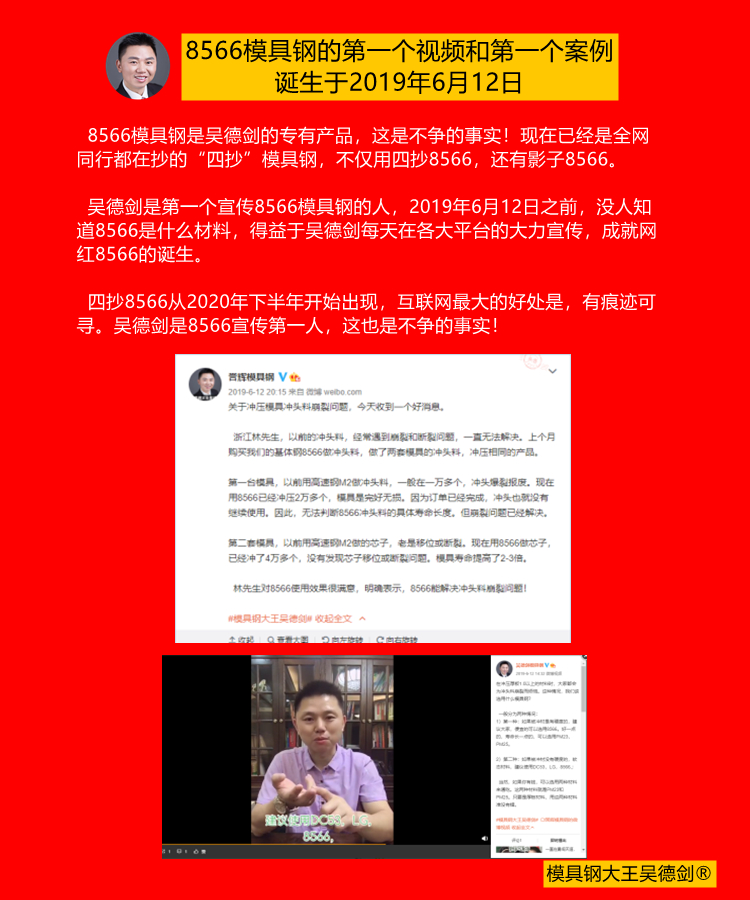
If you are also working with 4mm thick stainless steel, where the punch is prone to breaking and there is no solution, resulting in a short mold lifespan, then you can try using 8566 anti-breaking steel.
The anti-chipping performance of 8566 is four times that of high-speed steel SKH-9 and twice that of D2, with a hardness of 58-60HRC. It is primarily designed to address the chipping issues that high-hardness die steels such as D2, DC53, and SKH-9 cannot solve, especially in conventional mold steel applications such as stainless steel stamping, sharp corner stamping, narrow edge stamping, and thick plate stamping. For punch chipping, 8566 die steel is the solution. There’s a world of difference between the old and new societies.
Your punch is cracking and there’s no solution. You should try 8566 anti-cracking steel. After all, it won’t cost you extra money; you’re just using the cost of cutting the punch to buy tool steel. Plus, you’ll benefit from fewer mold changes, less punch cutting, and higher production efficiency. For us who engage in stamping production, what we want is high efficiency, not cheap tool steel for punches. If you keep changing punches, no matter how cheap the tool steel is, you won’t make any money.
I am Wu Dejian, the king of die steel, from Dongguan Yuhui Tool Steel. Yuhui Tool Steel is used by 3 Fortune 500 companies, and Kyocera has been purchasing Yuhui Tool Steel for 7 consecutive years. I have solved the difficult problems of mold material selection, production, and use for more than 4,000 enterprises. If you are hesitant when choosing die steel, or if the die steel you are currently using has a short service life, and you don’t know which material to use, welcome to come to me. I believe that in this regard, I can be your chief of staff and help you save money. Wu Dejian Tool Steel, the chief of staff of users, is well-received by those who have used it!