A netizen asked, “What are the common grades of plastic mold steel?”
Commonly used plastic mold steels are divided into three categories: pre-hardened plastic mold steel, rust-resistant plastic mold steel, and high-hardness plastic mold steel.
(1) Pre-hardened plastic mold steel is steel that has already been quenched and tempered by the steel mill to the desired hardness and can be directly machined into molds; its hardness generally ranges from 28 to 42 HRC.
Common grades of pre-hardened plastic mold steel include P20, 2311, 2738H, 718H, NAK80, and FDAC, which are primarily used for general-purpose injection molds or rubber molds.
Stainless steel pre-hardened grades include S136H, 2316H, 4Cr13H, and 2083H, which are mainly used for general-purpose plastic molds requiring rust resistance.
(2) Rust-resistant plastic mold steel refers to martensitic stainless steel that can be quenched and hardened, with a quenched hardness of HRC 50–56. Common grades include 4Cr13, 2083, S136, S136-D, M316, 2316, and M340, among others.
For applications requiring hard molds with rust resistance but where mirror-finish polishing is not a high priority, use 4Cr13, 2083, 2316, or standard S136.
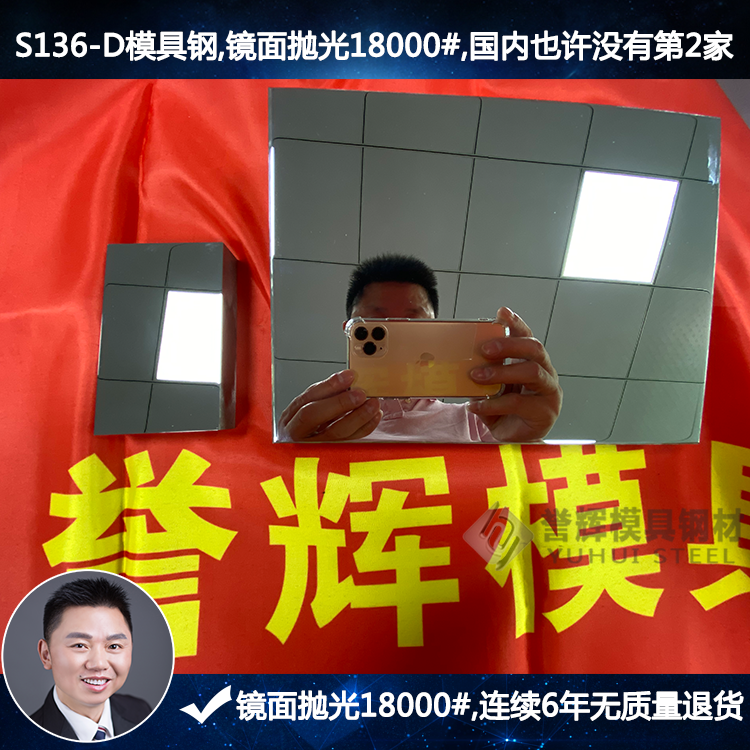
For applications requiring mirror-finish polishing, use S136 or S136-D of high metallurgical quality;
For injection molding of PVC and other strong acids, where exceptionally high corrosion resistance and rust prevention are required, use 2316, M316, or M340;
(3) High-hardness plastic mold steel is supplied by steel mills in an annealed condition. After rough machining, it is quenched and tempered to achieve a hardness of 50–60 HRC for use in hard molds.
For general-purpose hard molds requiring a hardness of around 50 HRC, in addition to the stainless steels mentioned above, you can also use hot-work die steels such as H13, 2344, SKD61, 8407, and 8418.
For glass-fiber-reinforced plastics with high glass fiber content, which place high demands on the wear resistance of the mold steel, use 8503 (a non-stick grade) for the core material, with a quenched hardness of 55–60 HRC.

8503 is a non-stick mold steel exclusive to Wu Dejian Mold Steel. It is not a national grade, but rather our company’s proprietary grade and our intellectual property; it is not in the public domain.
8503 has twice the toughness of DC53 and a hardness of 55–61 HRC. Compared to DC53, its performance is doubled without a corresponding increase in price, and it offers the added benefit of non-stick properties. In particular, this non-stick characteristic, combined with its high hardness, provides a fundamental and effective solution to the problems of molds used for high-glass-fiber-content parts—such as mold wear, product flash, and mold surface scuffing.
Mr. Yu from Ningbo said: “Using 8503 mold steel for glass-fiber-reinforced molds is really great—it can run continuously without any flash issues!” Mr. Wan also noted that 8503 can withstand 1 million mold cycles when injection molding nylon +30GF compounds.
For slant pins, inserts, and cores—which require high toughness and hardness—high-toughness LG mold steel can be used, with a hardness of 54–56 HRC; its toughness is so high that it will not fracture even when bent by impact.
When selecting materials for plastic molds, choose mold steel with properties that match the characteristics of the injection molding material. For some hard molds, it is necessary to balance hardness, wear resistance, and toughness.
*************
Wu Dejian’s tool steel, the chief of staff of the user, bought everything he had used.