Today I attended a seminar on expanding into Vietnam organized by the Guangdong Machinery and Mold Association. After listening to presentations by industry experts, I gained a general understanding of Vietnam.
Vietnam has a total population of over 100 million—equivalent to that of China’s Sichuan Province. The average working-age population is 38.8 years old, indicating a relatively young workforce. The average monthly salary for general employees is approximately 3,800 yuan, while technical staff earn an average of 7,500 yuan. However, with the increasing number of foreign-invested enterprises, both labor costs and rent are rising. At this point, labor costs are no longer a competitive advantage in Vietnam. The key advantage lies in Vietnam’s relatively low export tariffs; many Fortune 500 companies have set up factories there, so there may still be business opportunities.
One piece of information that surprised me is that, even though Vietnam purchases electricity from China, its industrial infrastructure is underdeveloped, there is a shortage of technical personnel, and the country faces power shortages and rolling blackouts.
When I think about it this way, China is still better. I know the anxiety that comes from factory equipment breaking down and being unable to find spare parts or repair technicians, leading to production halts—in Dongguan, this kind of problem basically doesn’t exist.
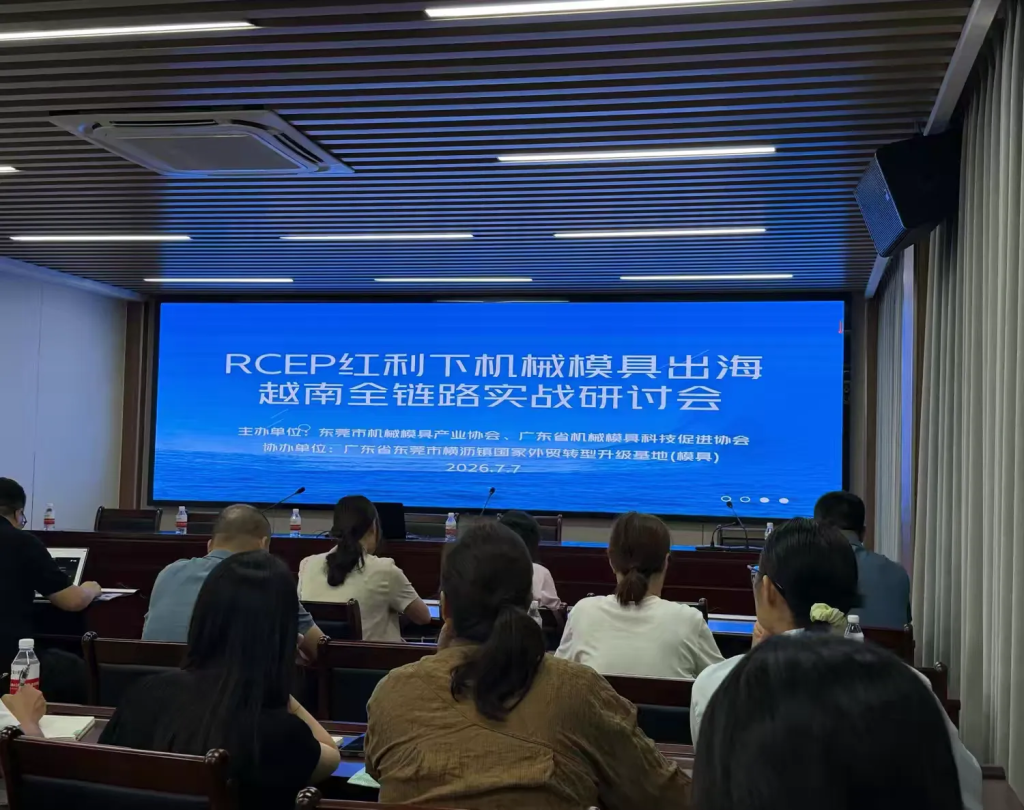
The second part of the conference was when the host discussed filming promotional videos at the factory. I didn’t expect the host to call on me specifically to speak, and when the microphone was handed to me, I was still a little nervous. I’m not used to speaking in such a large setting, so I’ll need to practice more in the future.
Because of this speech, many people came to add me on WeChat. Most valuable of all was an engineer from a German steel mill who approached me to discuss mold steel.
To be precise, he was a PhD in metallurgy. He was familiar with 8566 die steel and had even conducted research on it. He’d been wanting to talk to me for a while but hadn’t had the chance—so today’s occasion made it feel very natural.
He also expressed strong disapproval of the “four knockoffs” of 8566. What baffled him most was that, since some steel mills are imitating us and even calling their product “8566” outright, their tactics are simply too unscrupulous. The performance of mold steel is determined by impurity content, internal structure, and microstructural uniformity; alloy composition is just one factor among many. As professionals, they should know this, but I can’t understand why they would simply copy our alloy composition.
He also cited the example of a certain brand’s S136: theirs polishes well, but it’s expensive. Many so-called domestic S136 grades sell for only about twenty yuan per kilogram and are virtually impossible to polish—how can you even compare with them?
In this industry, while you’re working, others are watching. If you don’t play by the rules, it’s hard to earn respect—even if you’re very wealthy, people can choose not to do business with you.
Occasionally participate in industry association events and listen to what others have to say—you’ll gain a lot of insight and develop better judgment. At the very least, you’ll learn what not to do and what you shouldn’t do.
The biggest takeaway today is that everyone is making videos now, and there are no longer any in-person visitors. When everyone is making videos, we should be doing live streams.
There’s a mold factory that live streams every day—two shareholders, two accounts—conducting over 500 live streams a year. The impact that outsiders have on you really struck a chord with me.
*************
Wu Dejian’s tool steel, the chief of staff of the user, bought everything he had used.