During the 298th live stream, a viewer asked: What type of steel is best for hot-forging punches?
Hot-forging punches require high resistance to thermal wear. Thermal wear resistance is a comprehensive property that requires not only high heat resistance and high red hardness but also high hardness to ensure excellent thermal wear resistance. At the same time, toughness must be considered to prevent the punch from fracturing. In other words, red forging punches must be made from die steel that offers high heat resistance, high hardness, and high toughness. Otherwise, the punch will not withstand the stress and will anneal, leading to corner collapse, wear, or fracture failure.
If your production volume is low and you have no specific dimensional tolerance requirements for the stamped products, and you are looking for an inexpensive die steel, then H13 die steel is sufficient. Although H13 has poor red hardness and a short service life when used as a hot-forging punch, it is inexpensive.

Second, if you find that H13 has too short a service life but still want a low-cost die steel, use 3Cr2W8V die steel, which contains 8% tungsten. Its red hardness is better than H13’s, and it performs slightly better than H13 for hot-forging punches. However, 3Cr2W8V punches are prone to cracking right from the start of use, though they are relatively inexpensive.
Third, if you find that H13 has too short a service life and 3Cr2W8V is too prone to cracking—and you’re still not satisfied—if you have specific requirements for the surface finish of the stamped products, want a longer punch service life, and are willing to spend a little extra on the die steel, then you can choose 8566 die steel, which offers high heat resistance, high hardness, and high toughness.
The heat resistance of 8566 is on par with that of high-speed steel SKH51; it has a hardness of 58–60 HRC and four times the toughness of SKH51. 8566 strikes the perfect balance between high heat resistance, high hardness, and high toughness—a combination that other die steels cannot achieve.

Mr. Hu Song was hot-forging motor housings from No. 10 steel, with a forging height of 60–70 mm. When using HD mold steel for the punch and achieving a hardness of 50 HRC, the punch head would develop rounded corners and crack after producing only a few thousand parts. When the hardness was increased to 54 HRC, the punch head would chip off—essentially shatter—after producing only a small number of parts. Mr. Song was very frustrated by having to repeatedly remake the punches.
After he contacted me, I recommended this 8566 die steel, which offers high heat resistance, high hardness, and high toughness. He told me that a single punch can last for 200,000 products, meaning he’d have to make and replace punches less frequently, thereby increasing his production efficiency. Although I haven’t calculated exactly how many products can be produced per punch repair, a total lifespan of 200,000 products per punch is significantly better than what HD die steel can achieve. In March, Mr. Song came back to purchase another 50 pieces of 8566 die steel.
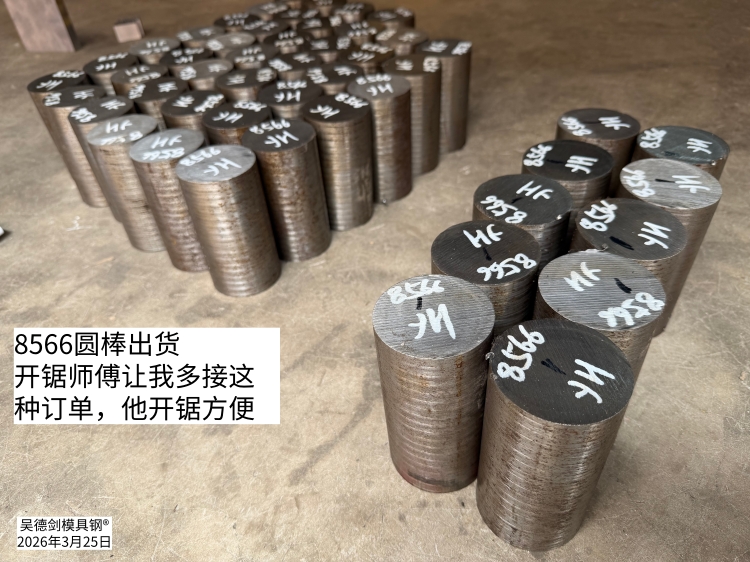
Hot-forging punches require high heat resistance, high hardness, and high toughness—only then can they withstand the process, achieve a long service life, and produce parts with a smooth finish.
As Mr. Zhang said, for hot forging 304 stainless steel, 8566 gets a five-star rating—the finished products have excellent surface finish, looking just like they were made from tubing.
If you ask me what steel to use for hot forging punches: if you’re looking for a budget option, H13 or 3Cr2W8V will do; but if you want high hardness, good toughness, and a long service life, use 8566 die steel.

When deciding which die steel to use, you need to consider a variety of factors, including your product’s structure, your requirements for punch life, and production costs. Some molds simply can’t afford punches that are too expensive.
*************
Wu Dejian’s tool steel, the chief of staff of the user, bought everything he had used.