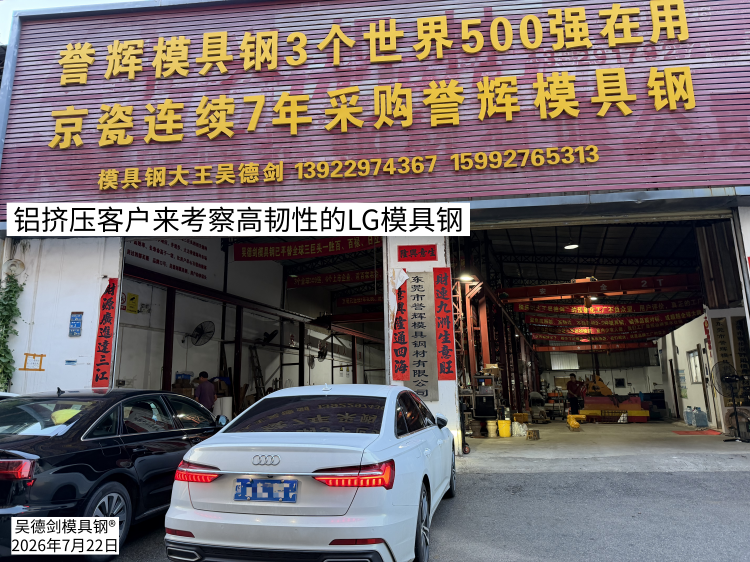
Today, a forging client visited our factory to inspect high-toughness LG die steel and shared some insights with me that I felt were worth noting.
In the forging and pressing market, current production capacity is still unable to meet future market demand. Therefore, although the technical barriers in the forging and pressing industry are high, market demand remains robust.
The first step in forging and pressing production is mold development, so there will be significant demand for forging and pressing mold steel in the future.
Currently, the main demand in the forging and pressing industry comes from new energy vehicles; future demand will stem from the fields of AI computing power and storage devices, which is expected to be several times greater than that for new energy vehicles.
The goal of new energy vehicle manufacturing is weight reduction. To ensure safety, components must possess high strength. In addition to using aluminum alloys to replace traditional steel, another method of strengthening is forging. Consequently, many structural components in new energy vehicles require forging processes, which in turn necessitate forging dies and, consequently, forging die steel.
Additionally, battery cooling systems—such as IGBT modules—require a large number of cold-forged parts made of copper or aluminum. Structural components for these systems also require a significant number of forged parts. The first step in forging is developing dies, which naturally requires die steel.
AI-related industries have an even greater demand for forging—several times that of the new energy vehicle sector. Structural components, cooling systems, and certain components in devices such as CPUs, graphics cards, switches, optical modules, and humanoid robots all require formed parts made of red copper or aluminum. These all necessitate forging processes, resulting in a very high demand for forging die steel.
Furthermore, dies for copper and aluminum forging are more prone to cracking than those for iron forging, so the die steel must possess exceptional toughness. Products manufactured using copper and aluminum components have very high aesthetic requirements—they must not exhibit wire-drawing marks—which places extremely high demands on the die steel’s non-stick properties. To ensure part strength, the forging ratio must be sufficient, which in turn requires the die steel to possess high strength and toughness.
High hardness, high toughness, and non-stick properties—these three key characteristics cannot be achieved by all die steels; perhaps only the high-toughness LG die steel can meet these requirements.
LG is a proprietary high-toughness material developed by Yuhui Mold Steel. Its toughness is 8 to 9 times that of DC53, with a hardness of 54–58 HRC. It is so tough that it won’t break even when bent by hand. Not only does LG offer high hardness and high toughness, but viewers in our live stream have also remarked that LG steel is the nemesis of red copper.
Hearing this information from industry insiders, combined with the track record of success built by LG die steel, has sparked my imagination and filled me with optimism for the future.
Society is progressing, and market demands are evolving. User expectations will only continue to rise—this is an unstoppable trend. When developing products, it’s not enough to focus solely on internal factors; you must also understand external dynamics and go with the flow. Only then can you truly make a difference.
*************
Wu Dejian’s tool steel, the chief of staff of the user, bought everything he had used.