“What kind of mold steel is best for copper die-casting molds?” This was the question asked last week by a customer who manufactures copper die-casting molds when he visited Yuhui to inspect the 8433 heat-resistant steel.
He specializes in copper die-casting molds. Currently, he uses 8407 and 8418 mold steel from a certain supplier. For smaller parts, the molds can withstand 7,000 to 8,000 die-casting cycles, but for larger parts, they only last 2,000 to 3,000 cycles before cracking and becoming scrap. This forces him to develop multiple sets of molds for a single product to meet production demands, resulting in not only low production efficiency but also high processing costs. He is looking for a mold steel with a longer service life for copper die-casting molds. While the procurement staff was searching online for mold steel, Doubao recommended the heat-resistant steel 8433, so they drove to Yuhui Mold Steel.
In copper die-casting molds, the molten copper must be heated to over 1,000°C, which causes severe erosion of the mold. Our mold steel must first possess high heat resistance; a high molybdenum content in the heat-resistant alloy is essential to withstand the erosion of molten copper, as the alloy composition forms the foundation of its performance.
Second, the smelting quality must be excellent. Only with high purity and low levels of the five major harmful impurities can the steel’s properties be safeguarded. Thorough forging ensures a uniform microstructure, eliminating both macroscopic and microscopic segregation, thereby allowing the performance characteristics designed into the alloy composition to be fully realized.
Finally, the heat treatment process must be optimal, with minimal internal stress, so that the mold steel’s properties can be fully realized.
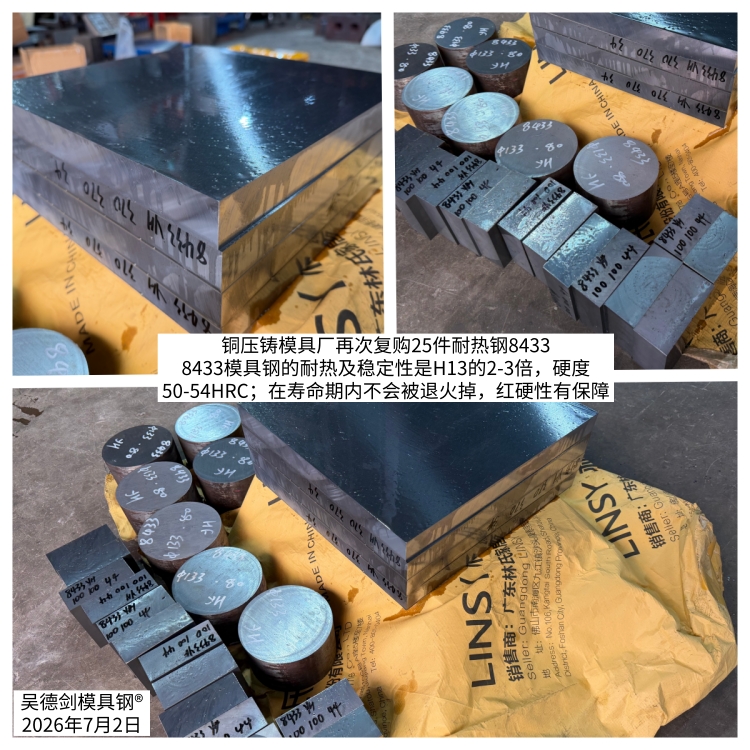
Regarding the 8407 and 8418 grades you selected for copper die-casting molds, these heat-resistant alloys have slightly lower molybdenum content, resulting in marginally poorer red hardness. Once the mold is annealed, none of its properties can be guaranteed.
For copper die-casting molds, based on our clients’ past experience, I recommend the heat-resistant steel grade 8433.
The heat resistance and stability of 8433 are 2–3 times that of H13, with a hardness of 50–54 HRC. It will not anneal out over its service life, its hardness will not decrease, and its red hardness is guaranteed; Furthermore, it is produced using high-quality smelting processes—specifically, a critical gas electroslag furnace—resulting in low levels of the five major harmful impurities. Additionally, through six-sided forging, three forging and three drawing passes, and pre-heat treatment, macro- and micro-segregation issues are eliminated. Combined with its proprietary heat treatment process, these three aspects are optimized simultaneously, thereby maximizing the heat resistance performance of 8433.

Many of our customers who manufacture copper die-casting molds previously used H13, Y4, or 8418, which resulted in short mold lifespans and a high susceptibility to cracking. They have all switched to the heat-resistant steel 8433 and report that its lifespan is 2–3 times longer than that of H13.
Another customer, who places bulk orders of 14 or 21 pieces each time, reported that his copper die-casting molds, now made from 8433, have a service life of over 30,000 cycles.
The main purpose of this video is to remind everyone that the operating conditions for copper die-casting molds are extremely harsh, with extremely high temperatures, so when selecting mold steel, you must prioritize high heat resistance, uniform microstructure, high purity, low levels of the five major harmful impurities, and the absence of segregation. The heat treatment process must also be appropriate. These factors work together—they are not isolated elements. Only when all aspects are optimized can you extend your mold’s service life. Don’t just focus on the alloy composition.
*************
Wu Dejian’s tool steel, the chief of staff of the user, bought everything he had used.