Mr. Jia is hot-forging hexagonal nuts. Currently, the bottom die is made of H13 and is kept submerged in water, but H13 is prone to wear—it typically wears out after 20,000 strokes, or it chips or cracks. What type of die steel would you recommend?
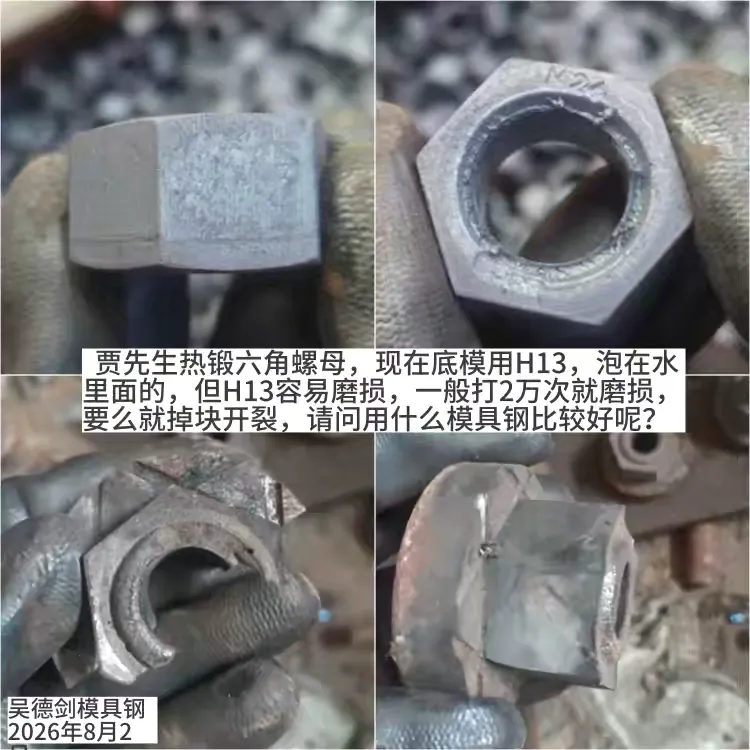
For hot forging dies, high heat resistance is the top priority. H13 is a chromium-based hot-work die steel with the chemical composition 4Cr5MoSiV1, containing 1.0% molybdenum (Mo) as a heat-resistant alloying element. However, the molybdenum content is too low, resulting in poor heat resistance. Therefore, when used in hot forging dies, the steel will anneal out quickly. Once the hardness decreases, the red hardness is lost, leading to die collapse and cracking. This results in poor-quality products and a short service life. The fact that his current H13 dies are prone to wear, chipping, or cracking further corroborates this point.
For hot-forging nut blanks, based on the heat resistance requirements for the die and our experience with successful past cases, I recommend the heat-resistant steel 8433.
8433 mold steel offers 2–3 times the heat resistance and stability of H13, with a hardness of 50–54 HRC. Throughout its service life, it eliminates the two major issues of die collapse and cracking. It is particularly worth emphasizing that 8433 maintains its service life even after repairs; even if the die is repaired to the point of scrapping, the hardness on the back surface will not decrease.
8433 is a proprietary heat-resistant steel developed by Yuhui Mold Steel. It currently far surpasses competing products in multiple performance metrics—including high heat resistance, fatigue resistance, high toughness, and high thermal conductivity—and its performance is among the very best in the industry. It is used by over 100 companies, including Fortune 500 firms, publicly traded companies, and large and medium-sized automotive parts manufacturers such as Valeo, South China Precision Forging, and Sanlian Forging.
Since 8433 prevents die collapse and cracking, it enables extremely high efficiency in automated forging and significantly reduces costs—it might as well be free. Therefore, if your hot-forging dies are prone to collapse or cracking, using 8433 die steel is even more satisfying than eating braised pork!

Mr. Bao was hot-forging 35CrMo hex nuts. The bottom die used for this process—made from 8433 steel—lasted twice as long as one made from H13. The H13 die cracked after 20,000 pieces, or the die collapsed and pieces broke off. whereas 8433 produced 40,000 pieces—and after 40,000 pieces, the die showed no signs of wear whatsoever. Production continued until the die was scrapped after 58,000 pieces; the photo shows the actual die at the 58,000-piece mark.
Based on the information provided by Mr. Bao, when hot-forging 35CrMo hex nuts with an 8433 die steel bottom die, the tool can produce 58,000 pieces—a service life three times that of H13.
Therefore, Mr. Jia, if you are currently hot-forging hex nuts using H13 for the bottom die—which is prone to wear and typically wears out after 20,000 cycles, or even chips or cracks—and your mold operating conditions are similar to Mr. Bao’s, I still recommend using 8433 die steel if you wish to extend the mold’s service life.
*************
Wu Dejian’s tool steel, the chief of staff of the user, bought everything he had used.