We received an inquiry from Mr. Huang regarding a progressive die for single-step fine blanking of 4.0-thick TM500 pickled sheet. The gear teeth are quite small, and the current punches are prone to chipping—they chip after only a few hundred pieces, making production impossible. What type of die steel should be used for this gear fine blanking die?
Mr. Huang is using a progressive die for single-step fine blanking of 4.0-thick TM500 pickled sheet metal, with a single-side clearance of 0.025. The gear product requires a fully bright finish. The punches have been coated, but they are prone to chipping, and he has tried many different types of die steel. Initially, ASP23 punches with a hardness of 64–66 HRC were used, but they chipped easily after just a few hundred punches. Later, SKH-9 punches with a hardness of 62–64 HRC were tried, but they also chipped after a few hundred punches. Currently, DC53 is being used, but it chips after 5,000 punches; however, if the hardness is too low, the part becomes distorted. What die steel should be used for precision blanking dies with sharp corners?
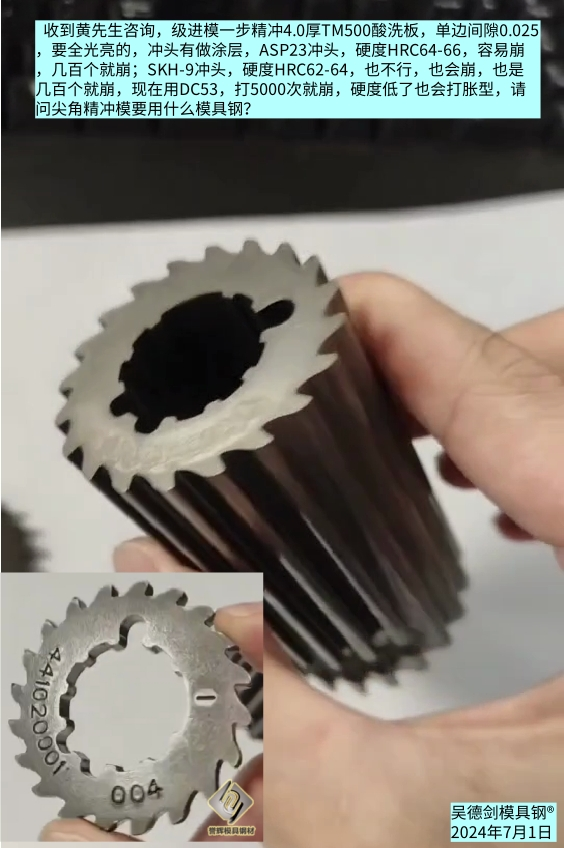
Fine-blanking parts require a fully polished surface, tight die clearances, and high punching forces, placing extremely high demands on the die steel’s resistance to chipping. High hardness can cause the steel to burst under compression; for gear parts with sharp corners, where the load-bearing surface is small, the demands on the die steel’s strength and resistance to chipping are even higher—if the hardness is too low, the corners will collapse; if it’s too high, the corners will chip. He is currently using ASP23 powdered high-speed steel, SKH-9 high-speed steel, and DC53, all of which experience corner chipping after punching just a few hundred parts, which confirms this issue: precision stamping dies for gears are prone to corner chipping and are difficult to work with.
ASP23 is a powder-metallurgically produced high-speed steel with a carbon (C) content of 1.3%, tungsten (W) content of 6.5%, and vanadium (V) content of 3.0%. It has a hardness of HRC 64–66. With its high carbon, high alloy content, and high hardness, it offers excellent wear resistance and red hardness. However, since the material is excessively hard, it is normal for it to be prone to corner chipping, and it is also extremely expensive.
SKH-9 is a conventional cast high-speed steel with a carbon (C) content of 1.0%, tungsten (W) content of 6.0%, vanadium (V) content of 2.0%, and a hardness of HRC 62–64. It suffers from severe microstructural segregation, making it even more prone to chipping, and its wear resistance is inferior to that of PM23. It’s no surprise that it chips after punching just a few hundred parts—this is an inevitable outcome.
DC53 is a high-carbon tool steel with a carbon content of 1.0% and the chemical composition Cr8Mo2VSi. It has a hardness of 60–62 HRC and offers good wear resistance. While its total alloy content is relatively low, its resistance to chipping has been improved; however, microstructural segregation remains severe. The inherent drawback of high-carbon steel—being hard yet brittle—means that chipping is inevitable when used in precision stamping dies with sharp corners.
Precision stamping dies require high machining accuracy; they are all produced using slow-wire EDM, with a “cut once, repair three times” approach. Wire EDM is very expensive and time-consuming. If the die cracks after producing just a few hundred parts, it must be repaired—not only does this halt production, but the resulting cost losses are also significant. By purchasing die steel with good crack resistance, you can reduce the need for repairs and improve stamping efficiency—in effect, the die steel becomes virtually free to use.
For similar fine-blanking dies with sharp corners that demand extremely high crack resistance, I recommend 8566 crack-resistant steel.

8566 is a proprietary chip-resistant mold steel from Yuhui, designed primarily to address mold chipping issues; it has been used in over 1,000 applications across 5 stamping conditions, 6 major material types, and 7 major industries. The chipping resistance of 8566 is four times that of SKH-9 high-speed steel and twice that of D2, with a hardness of 58–60 HRC. It can resolve chipping issues that high-hardness mold steels such as D2, DC53, and SKH-9 are unable to address.
In particular, under demanding conditions—such as stainless steel stamping, thick-gauge sheet metal stamping, fine-blanking dies, sharp-corner stamping, narrow-flange stamping, and stamping where the hole diameter is smaller than the sheet thickness or the stamping ratio is less than 1:1—8566 die steel effectively resolves die chipping issues and significantly extends die life.

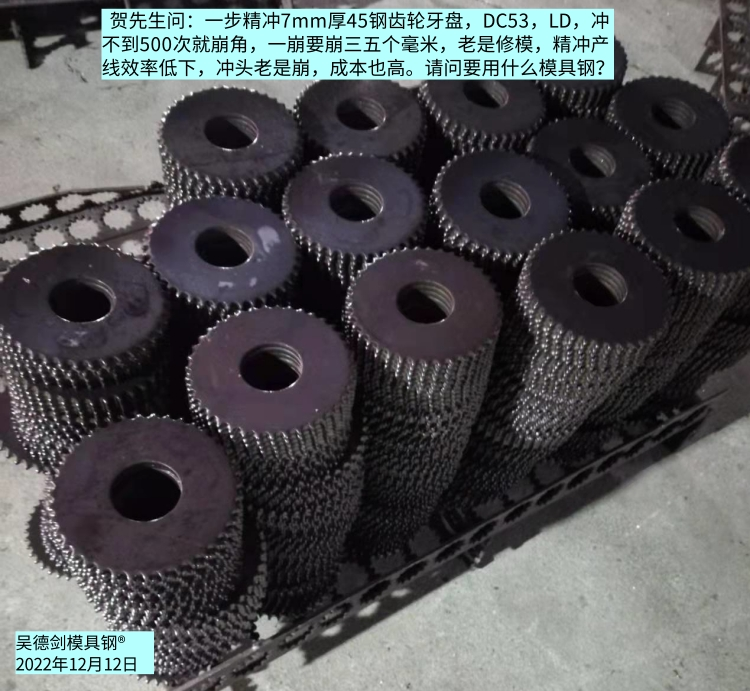
Mr. He was precision punching 7mm-thick 45 steel gears. When using a DC53 punch, the punch would chip after 2,000 products—chipping off large chunks at a time, with each chip measuring 3–5 mm. Later, he switched to LD, which reduced the hardness, but even then, the punch could only produce 5,000 products before chipping off 2–3 mm. This required constant die repair, resulting in low production capacity on the precision punching line.
However, after switching to 8566 chipping-resistant steel for the punches, the line could produce 25,000 parts per run without any chipping at the corners—effectively extending the punch life by five times. The cost was equivalent to purchasing the material at 20% of the original price, resulting in reduced material consumption, lower wire-cutting costs, and decreased mold repair expenses, while stamping efficiency increased fivefold.
Mr. He precision-punches 7mm-thick 45 steel gears using 8566 chipping-resistant steel for the punches, achieving a fivefold increase in service life, reduced die repair costs, and improved efficiency. Mold steel purchased at 20% of the original price is practically free. Using 8566 die steel for punches makes the difference between the old and new worlds.
Mr. Huang’s progressive die performs precision stamping of 4.0-thick TM500 pickled sheet in a single step. Currently, ASP23 powdered high-speed steel and SKH-9 high-speed steel both suffer from chipping after just a few hundred products. Even DC53, after its hardness is reduced, can only handle 5,000 products. I recommend you use 8566 anti-chipping steel—just like Mr. He did. It’s a one-time investment with four major benefits—it’s absolutely fantastic.
*************
I am Wu Dejian, the “King of Mold Steel,” from Dongguan Yuhui Mold Steel. Yuhui Mold Steel is used by three Fortune 500 companies, and Kyocera has been sourcing our products for seven consecutive years. I have helped over 4,000 companies solve complex challenges related to mold material selection, manufacturing, and usage. If you’re unsure about which mold steel to choose, or if the steel you’re currently using results in short mold lifespans, or if you’re unsure which material to use, feel free to reach out to me. I’m confident I can serve as your trusted advisor in this area and help you avoid costly mistakes. Wu Dejian Mold Steel—your trusted advisor—and customers who’ve tried us keep coming back!