Hot forging dies require high heat resistance to prevent annealing, which can lead to a decrease in hardness, die collapse, and cracking—all of which shorten the service life of hot forging dies. When it comes to hot-forging dies for standard nuts, everyone prefers to use tungsten carbide dies because of their excellent heat resistance, high hardness, and good wear resistance, which ensure a long die life. However, since the price of tungsten carbide has tripled, many manufacturers can no longer afford to use it for hot-forging nut dies, so they are looking for tool steel to replace it.
Mr. Li approached me today. He specializes in hot-forged nuts. He recently made two dies for a client—one made of tungsten carbide and the other of tool steel. However, after producing only 1,000 to 2,000 pieces with each, deep cracks appeared along the die’s cutting edges, rendering both dies unusable. He asked me what type of tool steel should be used for hot-forged nut dies.
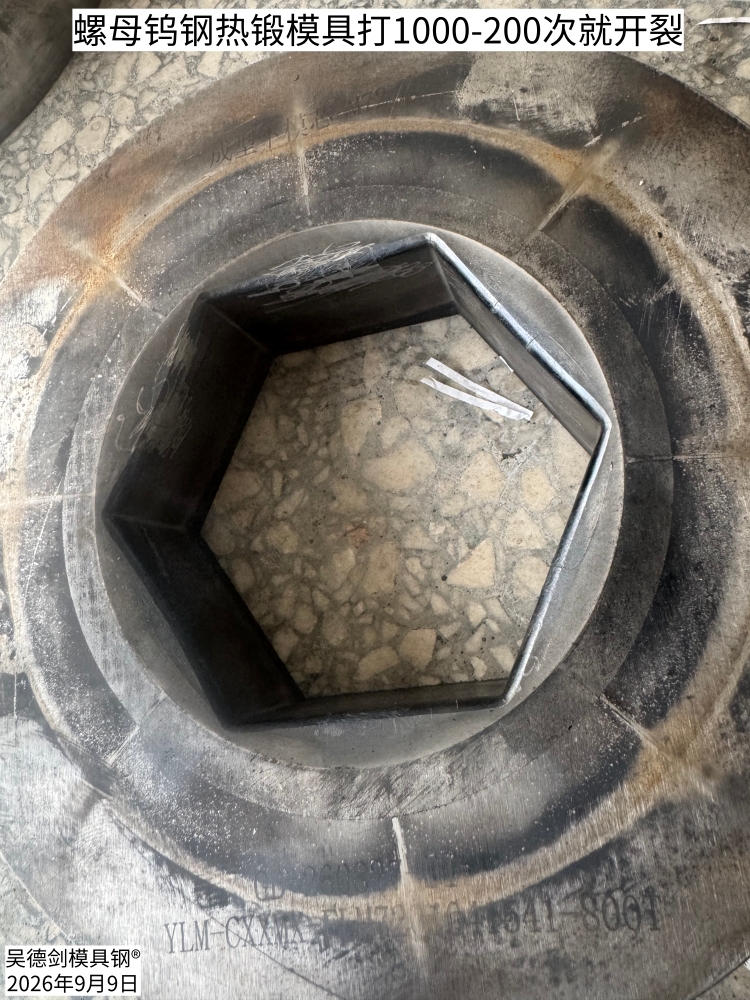
Many of our customers who do hot forging of nuts use 8566 die steel as a substitute for tungsten carbide. Hot forging dies for nuts are typically purchased in 180-diameter sizes, and customers usually buy several at a time. He used to use tungsten carbide dies as well, Tungsten steel dies have a long service life and work perfectly well, but after the price tripled, customers stopped doing business with him, and he couldn’t get any orders. This forced him to search everywhere for materials. After comparing various options, he has now switched to 8566.
8566 hot-forged nut dies can last for tens of thousands of cycles, and the price is only one-tenth that of tungsten steel. When you do the math, 8566 is still very cost-effective. His current customers for hot-forged nut dies now specifically request 8566 die steel.
The heat resistance and stability of 8566 are on par with those of high-speed steel SKH-51, with a hardness of 58–60 HRC and four times the toughness of SKH-51. 8566 strikes the perfect balance between high heat resistance, high hardness, and high toughness.
8566 is used for applications with particularly high requirements for thermal wear resistance and product surface finish. When used as a substitute for tungsten steel, 8566 offers the same service life while significantly reducing your costs.

My client told me that using 8566 for molds allows them to produce 20,000 to 30,000 units without any issues, and under optimal conditions, they can produce over 40,000 units. The client is very satisfied; all of their current hot-forging molds for nuts are made from 8566.
Thanks to its excellent heat resistance, 8566 maintains its hardness throughout the hot forging process, ensuring consistent hardness. Combined with its high hardness and superior thermal wear resistance, it delivers a long mold service life. Furthermore, its toughness is four times that of SKH-51; this superior toughness prevents the mold from cracking, resulting in beautifully formed products. As Mr. Zhang mentioned, when hot-forging 304 stainless steel, 8566 earns a five-star rating—the finished products have excellent surface finish, looking as if they were made from tubing.
This user asked me about their hot-forging die for nuts. They’re currently using tungsten steel and an unnamed die steel. After producing 1,000–2,000 parts, the die cracks at the mouth. They asked me what die steel they should use. Based on past success stories and the performance requirements for hot-forging dies for nuts, I still recommend 856 die steel for its high heat resistance, high hardness, and high toughness.
Tungsten steel hot-forging dies for nuts are too expensive; using 8566 die steel as a substitute reduces the cost to just one-tenth.
*************
Wu Dejian’s tool steel, the chief of staff of the user, bought everything he had used.