The premise of communication is trust, and someone who doesn’t trust you doesn’t need to communicate anymore.
The same person came to ask again a year later, stamping 2.4mm thick stainless steel. Now using DC53 with a hardness of 59HRC, it is easy to crack. Sometimes it can be punched 20000 to 30000 times, and sometimes it can only be punched 10000 times before the teeth break. What tool steel should be used for stamping 2.4mm thick stainless steel?
When you tell him and analyze it to him, stamping 2.4mm thick stainless steel is a thick plate hard material stamping, and the anti cracking performance should be given priority, otherwise the mold will crack quickly. The unstable lifespan of DC53 now is due to its poor anti cracking performance causing tooth breakage. You should first use 8566 anti cracking steel.
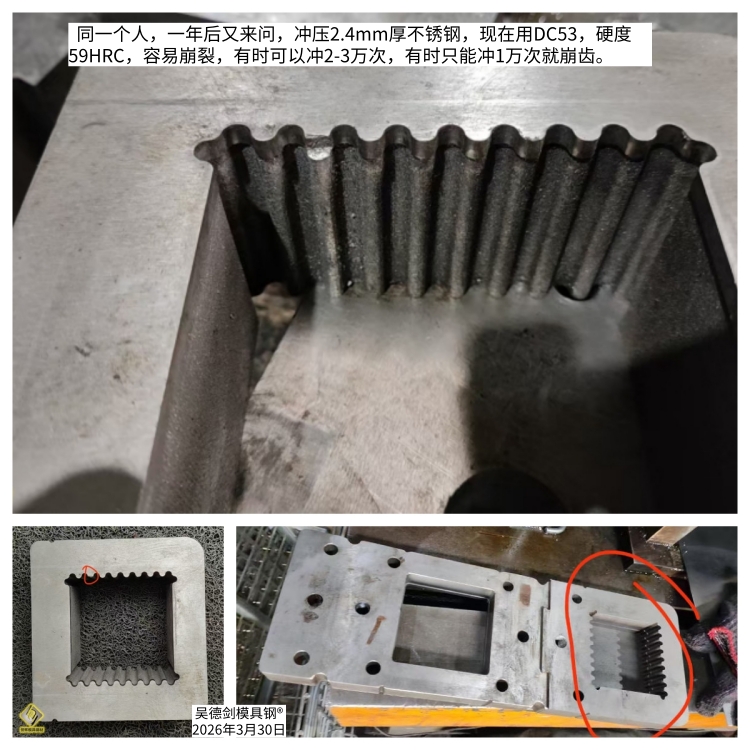
Because 8566 is a proprietary anti collapse steel developed by Yuhui Mold Steel, it mainly solves the problem of mold cracking; Its anti cracking performance is 4 times that of high-speed steel SKH-9, 2 times that of D2, and its hardness is 58-60HRC. It can solve the cracking problem that high hardness tool steels such as D2, DC53, and SKH-9 cannot solve; Especially in harsh working conditions such as stainless steel stamping, sharp corner stamping, narrow edge stamping, stamping aperture smaller than plate thickness, and stamping ratio less than 1:1, the cracking that cannot be solved by conventional tool steel is solved by using 8566 anti collapse steel.
He also said that the hardness of 8566 is too low and prone to wear and tear. This is a mold for punching and cutting materials. If it becomes soft, it won’t be wear-resistant. 201 stainless steel is relatively hard and now it will break teeth. Can the hardness of DC53 reach 63 degrees?
Returning to the old path, I asked about this working condition a year ago because DC53 is prone to tooth breakage. After two years of verification, it still has tooth breakage. I asked again a year later and said the same thing.
I told him again that your mold working condition should be considered first for the issue of collapse. Your DC53 has been verified for two years, but it still has teeth collapse, indicating that it is caused by poor anti cracking performance. How to require a hardness of 63HRC? It will die faster.
I’m getting a little angry using the word ‘die faster’.

But he continued to emphasize that 201 stainless steel is relatively hard and not wear-resistant when it becomes soft. Do you have any suggestions on this?
My suggestion doesn’t work. I suggested it to you two years ago and I gave it back today. I explained the situation and the selection process to you again, but you still have the same problem and refuse me with the same words. It means you don’t believe me at all. Whatever I say, you will refuse. Since you don’t believe me, there’s no need to continue communicating.
I said, if you think so, there’s nothing I can do. You can try using other materials.
Some people, if you are sincere, think you are going to cut their leeks. When you really cut their leeks, they say you are thinking of them.
A person who doesn’t want to cut chives will not be liked by chives.
*******
Wu Dejian tool Steel is the user’s chief of staff and everyone who has used it buys it.