What type of die steel is used for copper die casting? Current copper die casting molds have a short service life, and die casting factories now stock Heat resistant steel 8433.
Copper die casting molds operate at high temperatures, making the die steel prone to annealing; therefore, a die steel with excellent heat resistance must be selected. However, in addition to high heat resistance, it must also possess high thermal fatigue resistance, high toughness, and high erosion resistance. Only with excellent heat resistance can the hardness remain stable during high-temperature operation, preventing annealing and ensuring red hardness. This safeguards against mold collapse, cracking, erosion, or thermal fatigue cracking.
Current hot-work die steels such as H13, 8418, and 8407 have a short service life when used in copper die-casting molds. This is not due to insufficient thermal fatigue resistance, but rather because their heat resistance is too poor—specifically, the molybdenum content in these heat-resistant alloys is too low. As a result, the molds anneal prematurely after only a short period of use. Following repeated rapid cooling and heating cycles, thermal fatigue cracks appear on the surface, leading to failure.
The primary issue with copper die-casting molds is their poor heat resistance. They cannot withstand even 1,000 to 2,000—or even just a few hundred—castings before thermal fatigue cracks appear on the mold surface. This results in poor surface finish of the cast products and a short service life for the copper die-casting molds.
However, in addition to high heat resistance, copper die-casting molds must also possess high toughness and excellent thermal fatigue resistance. The tungsten-based hot-work die steel 3Cr2W8V should not be selected for copper die-casting molds. Although it contains 8% tungsten and no molybdenum, offering good heat resistance and red hardness, its toughness is too poor, and its resistance to erosion by molten metal is inadequate. Consequently, the mold is prone to cracking and is unsuitable for die-casting applications.
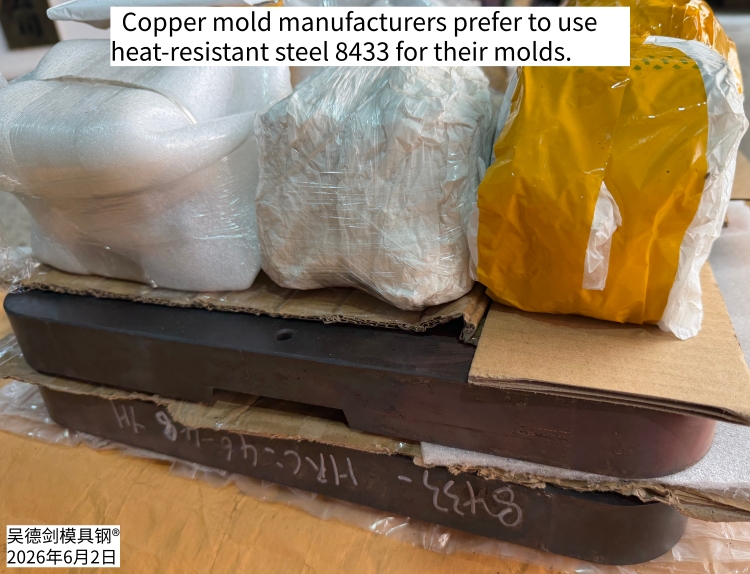
The heat resistance and stability of 8433 are 2–3 times that of H13, with a hardness of 50–54 HRC. and its performance metrics—including heat resistance, thermal stability, and resistance to thermal fatigue—far exceed those of H13 die steel. When used for copper die-casting molds, it is less prone to annealing and less likely to develop thermal fatigue cracks, resulting in a longer mold service life. Our customers prefer to use 8433 heat-resistant steel for their copper die-casting molds.
Seeing his mold reminded me of a few things, so I decided to record a video. If you’re currently using H13 or 8418 for your copper die-casting molds and experiencing short mold lifespans, or if you’re unsure which material to use, you should try heat-resistant steel 8433. Its heat resistance and stability are 2–3 times that of H13, with a hardness of 50–54 HRC. It won’t anneal out over its service life, and its hardness won’t decrease. ensuring consistent red hardness. Even if you repair the mold until it’s worn out, the hardness on the back surface won’t decrease. When used for copper die-casting molds, it lasts longer than H13 or 8418.
*************
Wu Dejian’s tool steel, the chief of staff of the user, bought everything he had used.