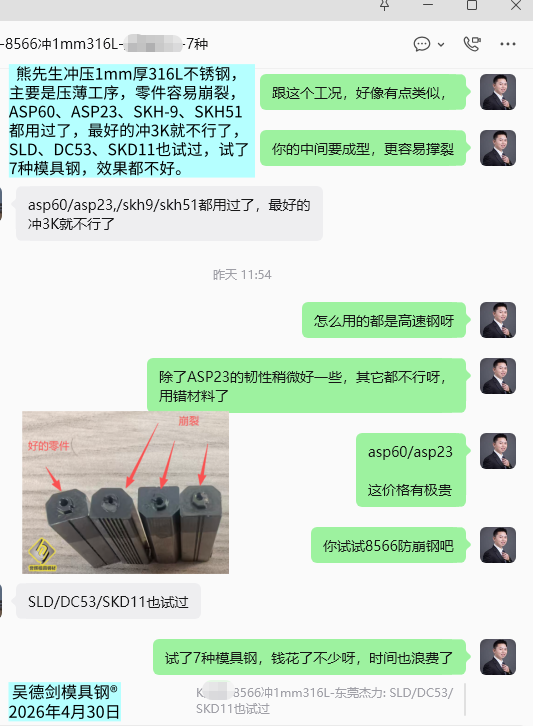
We tested seven types of die steel for stainless steel cold heading punches, but all were prone to chipping. Now that we’re using Yuhui 8566 anti-chipping die steel, the service life has increased tenfold.
Mr. Xiong’s die is used for stamping 316L stainless steel, approximately 1 mm thick, primarily for thinning operations. The parts were prone to chipping. We’ve tried ASP60, ASP23, SKH-9, SKH51—but even the best of these failed after just 3,000 strokes. We also tested LD, DC53, and SKD11.
Mr. Xiong contacted me in April. Given that his narrow-edge punches were constantly chipping—and considering he was working with the hard 316L stainless steel—I recommended switching to 8566 anti-chipping steel for his punches.
8566 die steel offers four times the crack resistance of SKH-9 high-speed steel and twice that of D2, with a hardness of 58–60 HRC. It effectively addresses cracking issues that high-hardness die steels such as D2, DC53, and SKH-9 cannot resolve; This is particularly true in harsh conditions such as stainless steel stamping, sharp-corner stamping, narrow-flange stamping with minimal overlap, and even situations where the punch diameter is smaller than the sheet thickness or the stamping ratio is less than 1:1. Chipping issues that standard die steels cannot resolve are all addressed using 8566 anti-chipping steel. Solving punch chipping is 8566’s specialty.
When Mr. Xiong came back today to purchase more 8566 die steel, I asked him, “Just to check in with you—has the punch chipping issue improved since your last purchase of 8566 die steel? How many products can you punch with the current batch of 8566?”
Mr. Xiong replied, “We’ve stamped over 30,000 parts and had only one failure—it’s much better than before.”
It seems the results are indeed much better. Compared to the seven types of die steel we tested previously, the best we achieved was 3,000 stampings. Now we can stamp 30,000 times, which means the service life has increased tenfold.

This 10-fold increase in service life offers three major benefits.
Benefit 1: With a 10-fold increase in service life, there’s no need to machine as many punches. This not only saves a significant amount on machining costs but also reduces the workload for mold technicians, freeing up their time for other tasks. The savings from reduced punch machining costs alone are enough to purchase many 8566 punches, effectively making the 8566 punches free to use.
Benefit 2: A 10-fold increase in service life means 10 fewer punch replacements and 10 fewer machine downtime events. The time saved translates directly into improved efficiency.
Benefit 3: While the service life of the punches has increased tenfold, the price of 8566 has not risen tenfold—in fact, it is even cheaper than the original material. With a 10-fold increase in service life and a decrease in costs rather than an increase, this cost-performance ratio is unmatched by other die steels. This also demonstrates once again that as long as the mold steel performs well, even the most expensive option is actually cost-effective.
When cold heading 1.0mm-thick 316L stainless steel to reduce thickness, seven different mold steels were tested. All the punches were prone to chipping, with the longest-lasting one lasting only 3,000 strokes. Now, using 8566 diel steel, we can produce 30,000 parts—a tenfold increase in service life. Yet the cost of the tool steel hasn’t risen; in fact, it’s even cheaper. It also offers three additional benefits. To say that using 8566 die steel for punch chipping is like moving from the old to the new world is no exaggeration.
Once again, 8566 die steel has helped our customers achieve low-cost, high-efficiency, and long-lasting performance. I’m in a great mood.
If your stainless steel punches are cracking, you should definitely try 8566 crack-resistant steel. The material cost for a small punch is low, but machining costs are high, and the cost of lost time is significant. With a 10-fold increase in service life, you won’t just save money—you’ll actually make money.
*************
Wu Dejian’s tool steel, the chief of staff of the user, bought everything he had used.