Mold components or workpieces may sometimes deform or crack after quenching. This is partly due to the workpiece’s shape and dimensions (complex geometry or excessive local dimensional variations).
It may also be caused by microstructural inhomogeneities within the workpiece (such as the presence of large inclusions, carbides, or machining cracks);
or due to operational factors in equipment and processes that cause significant temperature variations across different parts of the workpiece during heating and cooling, resulting in high stresses; partly due to the uneven formation of martensite, which generates internal stresses in the workpiece;
it is also related to the brittleness of high-carbon martensite and the formation of microcracks during its formation (or the formation of microcracks near inclusions or carbides).
Retaining a slightly higher amount of retained austenite within the workpiece can reduce deformation and cracking.
This is because austenite has greater ductility, which prevents excessive stress concentration, and because the reduced formation of martensite decreases stress, brittleness, and microcracks.
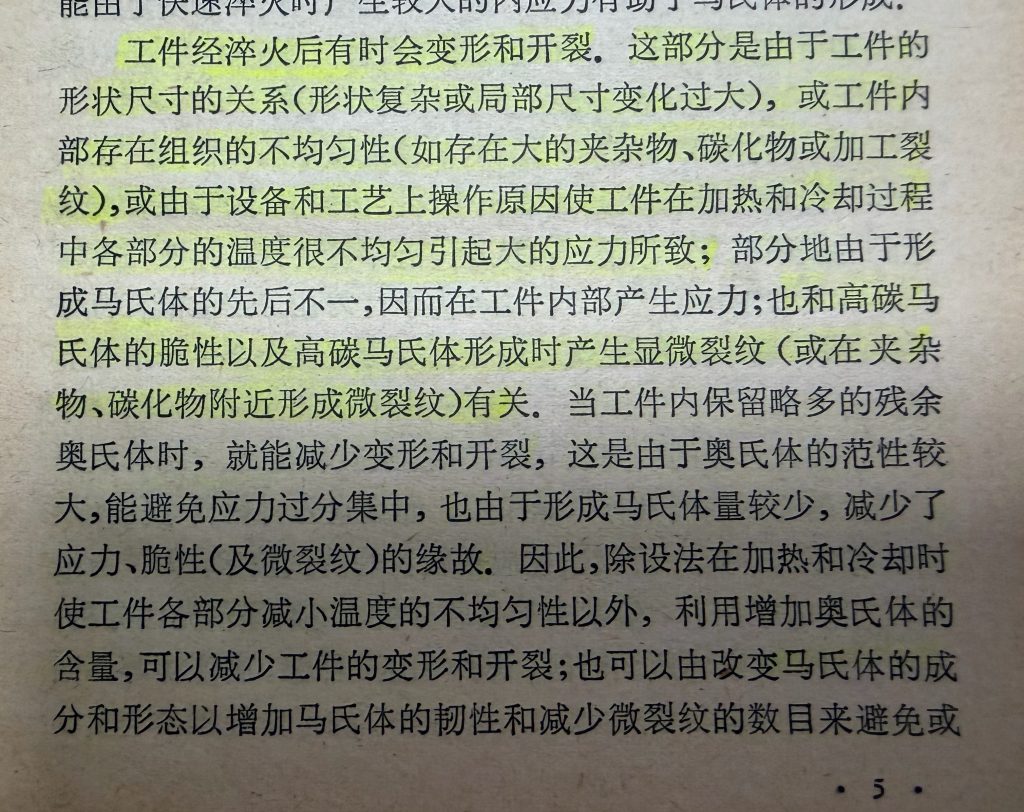
Therefore, in addition to minimizing temperature non-uniformity in various parts of the workpiece during heating and cooling, increasing the austenite content can reduce deformation and cracking in the workpiece; cracking can also be avoided or reduced by altering the composition and morphology of martensite to increase its toughness and reduce the number of microcracks.
This is the clearest explanation for deformation or cracking in mold components following heat treatment. Excerpted from *Martensitic Phase Transformation and Martensite*
*************
Wu Dejian’s tool steel, the chief of staff of the user, bought everything he had used.