Yesterday, a close colleague of mine called to chat. He said, “The biggest mistake you ever made was not registering the ‘8566 Crash-Resistant Steel’ trademark back when you were promoting 8566. Now all your competitors are copying and imitating you, and you can’t fight back.”
Not registering and protecting the “8566 Anti-Chipping Steel” trademark is indeed a regret.
But given the circumstances at the time, I was just a small player in the mold steel industry. I never imagined that an 8566 Anti-Chipping Steel product launched by a small company like mine would soon go viral online, becoming known as “Legendary 8566” and “Internet-Famous 8566.”
The popularity of 8566 chipping-resistant steel was a surprise—a livelihood bestowed upon me by fate. From start to finish, I never harbored any unrealistic ambitions; I just wanted to make a decent living from it.

Besides, in China, intellectual property is worth the least.
Looking back at our mold steel industry, the top three giants—such as a certain company’s S136, 8407, 8418, and 718H; and another company’s NAK80 and DC53—all have their own registered trademarks, but that hasn’t stopped everyone from copying them or imitating them in the slightest.
And precisely because of this rampant copying, S136, NAK80, and DC53 have now become synonymous with their respective steel grades. Our Yuhui-exclusive 8566 chipping-resistant steel is no different—it has now become the byword for chipping-resistant steel.
That said, for a company—a small player like us—to launch a best-selling product in our lifetime, one that’s widely imitated and copied by others, is a source of pride. After all, within the industry, aside from the “Big Three,” the only steel grade that’s been so widely imitated by all competitors is 8566—and Yuhui Mold Steel is the only company to receive the same level of attention as the “Big Three.” I have no reason to be unhappy about that.
I remember a steel mill that once wrote a one-sentence description for its own steel grade: “Performance identical to 8566, but at half the price.”
When I saw that line, I smiled to myself—it showed that 8566 anti-chipping steel was so well-known that steel mills couldn’t even be bothered to write out its performance specifications.
It also demonstrates that this product has genuinely helped users solve certain problems. Otherwise, it wouldn’t have achieved such market sales or brand recognition; customers wouldn’t specifically request it; and steel mills certainly wouldn’t cite 8566 to illustrate the performance of their own products.
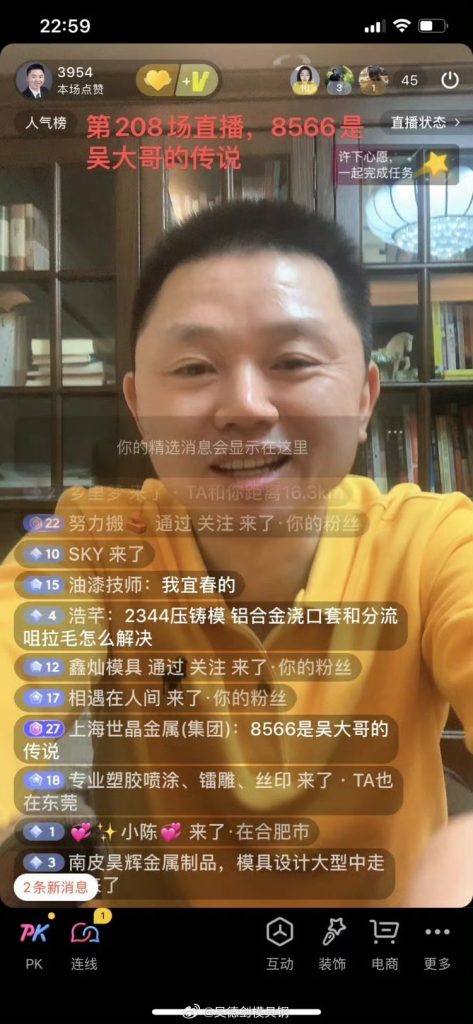
So, I have no regrets about the huge popularity of 8566 or the fact that it’s been copied four times by competitors. My only hope is that my peers won’t pass off fakes as the real thing, won’t substitute inferior products for the genuine article, and won’t compromise their integrity just for the sake of one or two orders.
We need to broaden our perspective a bit. It’s been a long time coming for a Chinese steel grade to gain widespread recognition, so we should protect it and do our best to perfect it. We must not only excel with it domestically but also take it to the international stage, making 8566 anti-cracking steel a globally recognized grade. Let’s stop just imitating the “Big Three” all the time—one day, we’ll have them learning from us instead.
“Use 8566 die steel for punch chipping—it’s like night and day.” I hope this message spreads not only domestically but also across the globe.
*************
Wu Dejian’s tool steel, the chief of staff of the user, bought everything he had used.