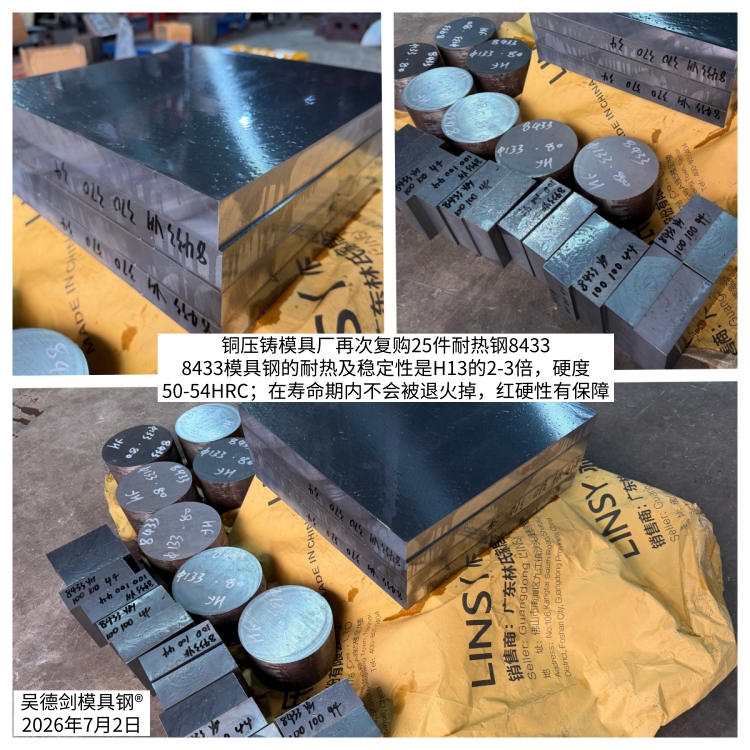
A copper die-casting factory once again purchased 25 pieces of heat-resistant steel 8433 from Yuhui for use in its copper die-casting molds.
The temperature of molten copper in copper die casting reaches 900°C, which exceeds the annealing temperature of die steel. Die steel with poor heat resistance is prone to annealing. Once annealed, it loses its red hardness, leading to mold collapse, cracking, erosion, and crazing—with crazing being the primary failure mode for copper die casting molds. For copper die-casting molds, mold steels with excellent heat resistance should be prioritized to withstand the erosion caused by molten copper. After comparing various mold steels, the customer began purchasing 8433 mold steel in bulk to manufacture his copper die-casting molds.
Currently, the main mold steels used for copper die-casting are H13, SKD61, 8407, and 8418. However, these steels have poor heat resistance and cannot withstand the erosion of molten copper at 900°C, leading to rapid thermal fatigue cracking and a short mold service life. Some have tried W321 and QRO90, but due to their high cost, manufacturers are reluctant to adopt them on a large scale.
W321 is a cobalt-added hot-work die steel with excellent heat resistance, which does extend the service life of copper die-casting molds. However, cobalt-containing die steels have poor toughness, making the molds prone to cracking. The main issue is that it is too expensive, so few manufacturers choose to use it. QRO90, which is highly recommended by a certain company, has a relatively high molybdenum content and contains neither tungsten nor cobalt, offering good toughness. However, it is also too expensive, so very few manufacturers of copper die-casting molds use it.
Because the service life of copper die-casting molds is so short, many people end up sacrificing the mold to obtain the parts. They cannot afford overly expensive mold steels and are forced to make do with heat-resistant steels like H13, SKD61, 8407, and 8418, which have poor heat resistance. However, after this particular customer tried the heat-resistant steel 8433, they began purchasing it in bulk—this time ordering 25 pieces.
The heat resistance and stability of 8433 are 2–3 times that of H13, with a hardness of 50–54 HRC. It does not anneal during its service life, so its hardness does not decrease, and its red hardness is guaranteed. As long as its hardness remains constant and it can withstand heat, it will have a long service life when used in copper die-casting molds. Furthermore, 8433 has a high thermal conductivity, allowing heat transferred from the molten copper to the mold to dissipate quickly, which also helps extend the mold’s service life. It is precisely because they witnessed these results that this copper die-casting mold customer decided to place a bulk order.
The fact that a customer is willing to purchase your mold steel in bulk indicates that they recognize the performance of 8433 mold steel and are satisfied with the mold’s service life; otherwise, they would not make repeat purchases.
If your current copper die-casting molds use H13, 8407, or 8418, and you’re experiencing short mold life—or if you’re unsure which mold steel to use and can’t afford the more expensive options—then you should try the heat-resistant steel 8433.

Based on current feedback from customers using 8433 for copper die-casting molds, the service life is quite good. Some users have reported that 8433 can last for over 30,000 cycles, but the exact number of cycles varies by manufacturer, so we won’t go into further detail here. If you want to extend the service life of your copper die-casting molds, we welcome you to try heat-resistant steel 8433.
*************
Wu Dejian’s tool steel, the chief of staff of the user, bought everything he had used.