DC53 is a die steel that has been overused to the point of exhaustion.
Mr. Wang from Cangzhou is stamping 3.75-thick hot-rolled Q235 steel sheets. The mold manufacturer said they used DC53, but the cutting edges need to be sharpened after only 20,000 strokes; otherwise, the products will have significant burrs.
When stamping 3.75-thick Q235 hot-rolled steel—which is neither particularly hard nor thick—DC53, with a hardness of HRC 60–62, should theoretically offer adequate wear resistance. It shouldn’t require edge regrinding after just 20,000 strokes. The fact that it wore out so quickly indicates that the quality of the DC53 steel used was very poor.

As for today’s DC53, aside from the alloy composition—which is still Cr8Mo2VSi—the necessary purification processes are no longer performed; so what if there are a few more impurities? The required forging processes are also omitted; so what if the density is a little lower? The necessary heat treatment processes are skipped as well; after all, customers want low prices, not high quality. If the dies wear out quickly, they can just use more die steel—which is good for everyone.
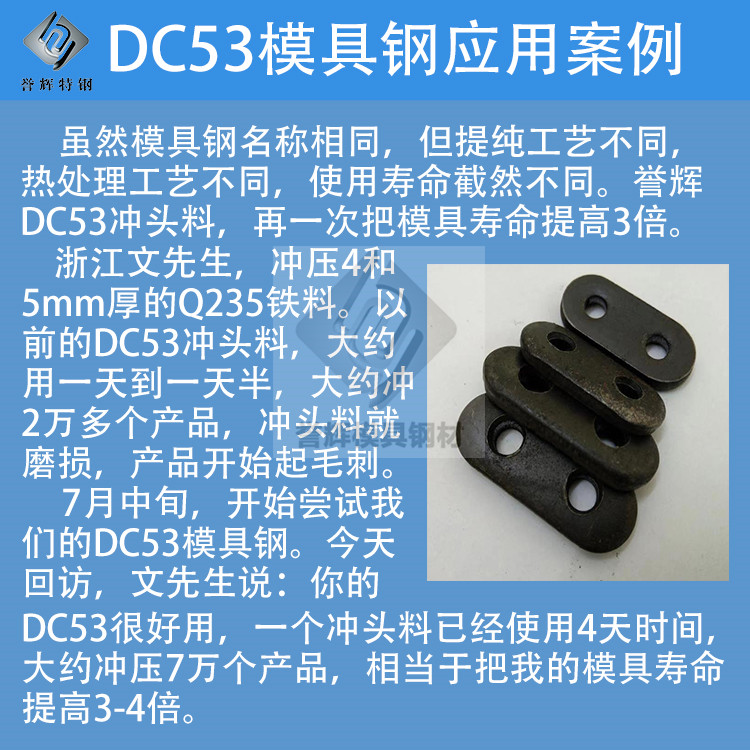
I recall a customer of ours who also stamped Q235 hot-rolled sheet. Mr. Wen was stamping 5mm Q235—also hot-rolled sheet—using locally sourced DC53 from Zhejiang. After just 20,000 stampings, burrs began to appear; the die could only last one to one and a half days, and the product developed significant burrs, requiring the cutting edges to be ground down.
However, when using Yuhui’s custom-made DC53, the die lasted 4 days and produced 70,000 parts—a threefold increase in service life.
Although they’re both technically called DC53 die steel, why is there a threefold difference in service life when stamping the same material? The reason lies in the differences in smelting quality, forging processes, and heat treatment processes—not in the alloy composition. And it’s certainly not the case that simply meeting the alloy composition specifications guarantees performance.
Keep in mind that while the price is only slightly higher, the service life is three times longer. This isn’t just a matter of reducing mold repairs by three times—it’s equivalent to purchasing Yuhui DC53 at 30% of the price. In other words, the cost is lower, requiring fewer wire-cut punches, resulting in lower machining costs, fewer punch replacements, less physical strain on workers, and improved stamping efficiency.
On the other hand, while DC53 may seem cheaper at first glance, its actual cost is three times higher. Machining costs increase, and stamping efficiency decreases—so your losses extend far beyond just the cost of the die steel.
Please remember: high-performance die steel isn’t sold based on its alloy composition, but on its smelting process. Adding alloy elements requires no special technical skill; the real challenge lies in mastering purification, forging, and heat treatment processes—these are a company’s core competitive advantages.
Therefore, Mr. Wang, when stamping 3.75 Q235 hot-rolled steel sheets, the DC53 punch requires edge sharpening after just 20,000 strokes. You should switch to DC53 with superior smelting quality. This will not only extend the punch’s service life but also reduce material costs and improve stamping efficiency—this is the true path to cost reduction and efficiency gains.
*************
Wu Dejian’s tool steel, the chief of staff of the user, bought everything he had used.