Mr. Jin said, “I was rough-blanking 3mm-thick pickled sheet metal. I bought the same piece of DC53 hard steel from Kunshan and used wire-cut dies to make the punches. The first one cracked after punching 20,000 pieces, and now this second one has cracked after only 2,000 pieces. What could be the cause?”
Indeed, when punching 3mm-thick pickled sheet—a material that isn’t particularly hard—and performing rough blanking with a large die clearance, DC53 shouldn’t crack. Furthermore, since both punches were wire-cut from the same piece of material and used in the same die, their service lives should theoretically be similar. Yet the results differ by a factor of ten, which naturally raises questions for the user and warrants further investigation.

In theory, high-quality DC53 steel—with a hardness of 60–62 HRC and twice the crack resistance of SKD11—should prevent the punch from cracking when used to stamp 3mm-thick pickled sheet metal that isn’t particularly hard. I recall our client, Mr. Su, who performed zero-clearance fine blanking on 3mm-thick pickled sheet metal using Yuhui DC53 for the cutting edge. After stamping 300,000 products, he never encountered any cracking issues.
However, the DC53 he recently purchased locally in Suzhou was prone to chipping and wear when precision punching 3mm-thick pickled sheet. Since Yuhui DC53 does not chip, Mr. Su was very pleased. He said, “Your DC53 is truly excellent. It’s reasonably priced, yet it delivers several times the service life.”

However, today’s DC53 die steel retains only its alloy composition; all other smelting processes have been completely altered. Yet it is still called DC53, leading many users to mistakenly assume that since it bears the same name, its performance is identical. In reality, due to differences in smelting quality, the morphology of carbides, the degree of segregation, particle size, and distribution vary; and, more importantly, due to differences in heat treatment processes and microstructural states—when these various factors are combined, the resulting wear resistance and fracture resistance are fundamentally different.
Yet, many suppliers use the mere fact that their product meets the standard for this single alloy composition to claim they are “GB DC53,” offering it at a very low price and touting it as high value for money. This is how they educate users, and many users have been misled by this.
This is precisely why products sharing the same technical designation of DC53 can have vastly different service lives. However, such technical nuances are beyond the discernment of the average user. Because they cannot distinguish these differences, users tend to focus solely on price when purchasing DC53 die steel. This misleads many mold steel suppliers, who then go to great lengths to reduce prices.
To cut costs, steel mills cut corners wherever possible—omitting smelting processes wherever feasible and skipping heat treatment steps whenever possible. This results in severe segregation in the produced mold steel, disrupting the continuity of the base material and reducing the steel’s resistance to chipping; Furthermore, the coarse and uneven grain distribution reduces the wear resistance of DC53. Combined with inadequate heat treatment and high internal stresses, this accelerates chipping and cracking in DC53. Consequently, the more users focus on price, the poorer the performance becomes. Mr. Jin’s current experience with DC53—where chipping and cracking issues arise after just 2,000 stamping cycles when punching 3mm pickled sheet of soft material—further corroborates this point.
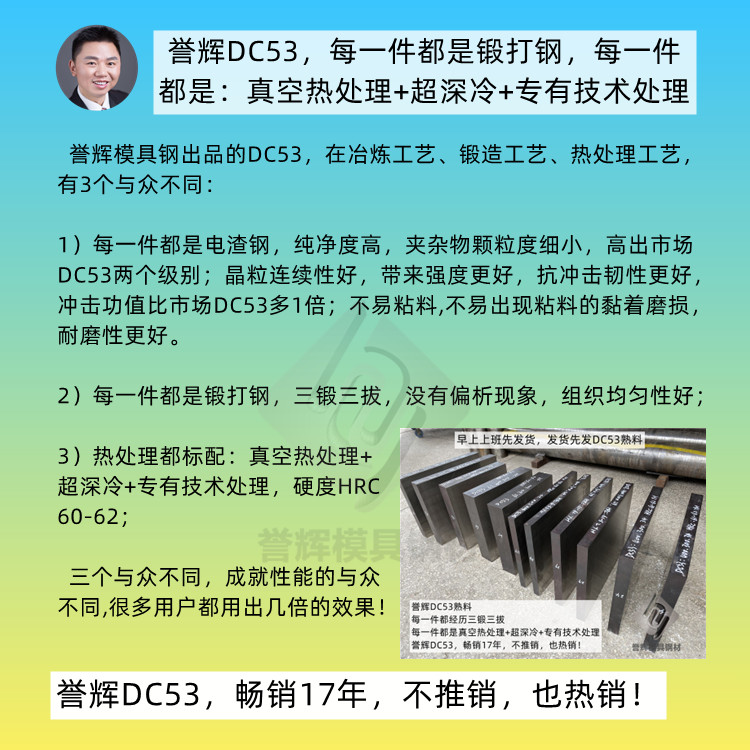
Due to variations in smelting quality and differences in heat treatment processes, DC53 is generally classified into 5 to 6 grades in the market. However, Wu Dejian DC53 adheres to its own smelting standards and proprietary heat treatment processes to ensure the performance and service life of the material. Wu Dejian’s custom-made DC53 products have three distinctive features:
1) Every piece is produced using the electroslag remelting process, resulting in high purity and low levels of the five major harmful impurities. This ensures the continuity of the base material remains intact, which is the fundamental and effective method for guaranteeing DC53’s resistance to spalling. Imported DC53 does not utilize the electroslag process.
2) Every piece is forged steel, undergoing six-sided forging with three forging and three drawing passes. This ensures excellent microstructural uniformity, eliminates segregation, and significantly improves the internal structure—a fundamental and effective method for guaranteeing DC53’s wear resistance, which low-cost mold steels cannot achieve.
3) Every piece undergoes pre-heat treatment and Wu’s proprietary heat treatment process, aimed at refining the grain structure, altering the microstructure, and enhancing both strength and toughness—a process that competitors neither conceive of nor can replicate.

Mr. Su, mentioned earlier, used a die made by Yuhui DC53 to perform zero-gap precision stamping of 3mm pickled sheet metal. After stamping 800,000 products, the die showed no signs of cracking. This not only defied Mr. Su’s expectations but also surprised me. The exceptional performance of Yuhui DC53 is attributed to the combination of its proprietary technologies: electroslag remelting, six-sided forging, three-stage forging and three-stage drawing, and specialized heat treatment processes. These factors result in superior overall performance and a long service life.
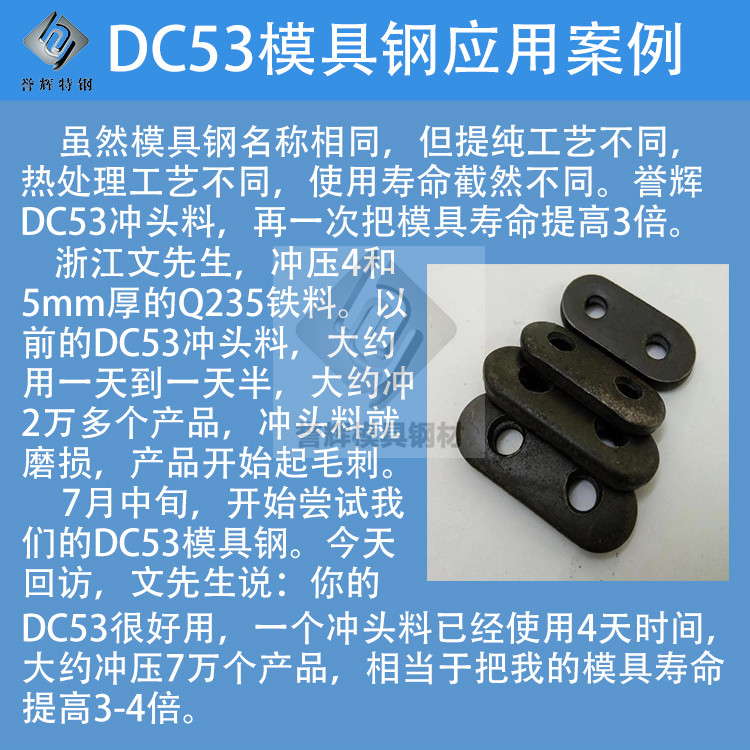
Then there’s Mr. Wen, who stamps 5mm-thick Q235 hot-rolled steel. Previously, when using standard DC53 for his punch material, wear would set in after about a day and a half—or just over 20,000 products—resulting in burrs on the finished parts. But after switching to Yuhui DC53, he could stamp for four full days—producing 70,000 products—which equates to a 3- to 4-fold increase in mold lifespan.
A 3- to 4-fold increase in service life translates to a 3- to 4-fold reduction in costs. This level of value for money cannot be achieved with inferior DC53 steel. You also benefit from reduced mold maintenance and replacement, lower machining costs, and improved production efficiency—all while achieving low-cost, high-efficiency, and long-lasting performance.
Mr. Jin was performing rough punching and blanking on 3mm-thick pickled sheet metal. He purchased DC53 steel in Kunshan. Two punches were cut from the same piece of material; one cracked after 20,000 punches, while the other cracked after fewer than 2,000 punches. This is clearly abnormal, and the quality of the DC53 he purchased is questionable.
Although rough blanking involves large die clearances and low burr requirements, DC53 has a hardness of 60–62 HRC and twice the crack resistance of SKD11. I believe that DC53 produced with high-quality smelting can be trusted for these operating conditions. Based on the stamping case studies from our Mr. Su and Mr. Wen, the service life is definitely more than 20,000 strokes, and it won’t chip or crack. I think you should try Yuhui DC53 to experience the cost-performance ratio with double the service life, rather than settling for the false value of low prices.
*************
I am Wu Dejian, the “King of Mold Steel,” from Dongguan Yuhui Mold Steel. Yuhui Mold Steel is used by three Fortune 500 companies, and Kyocera has been sourcing our products for seven consecutive years. I have helped over 4,000 companies solve complex challenges related to mold material selection, manufacturing, and usage. If you’re unsure about which mold steel to choose, or if the steel you’re currently using results in short mold lifespans, or if you’re unsure which material to use, feel free to reach out to me. I’m confident I can serve as your trusted advisor in this area and help you avoid costly mistakes. Wu Dejian Mold Steel—your trusted advisor—and customers who’ve tried us keep coming back!