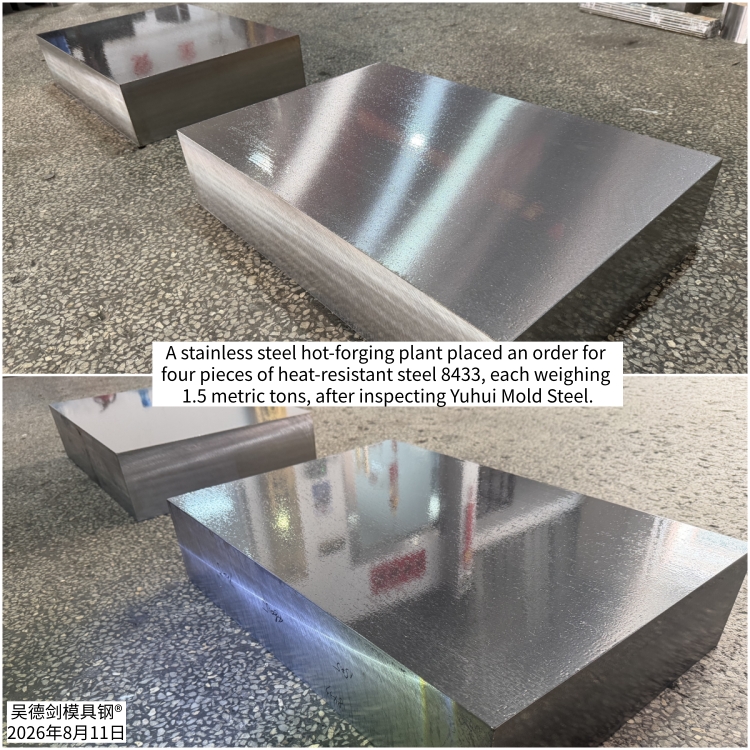
I saw two large pieces of 8433 heat-resistant steel ready for shipment in the workshop, which put me in a good mood. These two pieces weigh over 700 kilograms; we produced a total of four pieces this time, weighing one and a half metric tons in total.
This customer manufactures hot-forging dies for stainless steel. The dimensions are quite large—700 × 500 mm, with heights of either 130 mm or 150 mm. They’re currently using H13 die steel, but the dies are wearing out too quickly. In his own words, “The time spent repairing the dies is less than the time they’re actually in use; we can’t even keep up with the repairs.” A couple of days ago, the owner rushed over to our Yuhui Die Steel facility to inspect our 8433 heat-resistant steel. After the inspection, he placed an order for four pieces of 8433—a total of one and a half metric tons. Landing such a large order is quite satisfying, so today we shipped the order and decided to record a video to mark the occasion.
If your hot-forging dies currently use H13 and suffer from poor heat resistance—resulting in frequent die collapse and cracking that you can’t seem to resolve—and if the repair costs are too high and you don’t want to constantly repair them, then you should try heat-resistant steel 8433.
The heat resistance and stability of 8433 are 2–3 times that of H13, with a hardness of 50–54 HRC. It won’t anneal out over its service life, ensuring reliable red hardness. Most importantly, even if you repair the die until it’s worn out, the hardness on the back surface won’t decrease.
We have a customer who hot-forges 42CrMo flanges. Their original mold used H13, and the mouth area would collapse and crack after just 3,000 cycles. However, after switching to heat-resistant steel 8433, they only had to resurface the mold four times without any reduction in service life—each mold lasted over 10,000 cycles, which is three times the lifespan of H13. As Mr. Xin put it, “One of your molds is equivalent to four of our original H13 molds.”
While H13 is indeed inexpensive for hot-work dies, its heat resistance is simply too poor. It is a 4Cr5MoSiV1 alloy with an insufficient molybdenum content. During use, the die’s hardness is annealed out. Once this happens, its red hardness and resistance to thermal wear are lost, leading to die collapse and cracking. Furthermore, with H13, the entire die is annealed. A new die might last for 1,000 strokes, but after one surface reduction, that drops to 600 strokes; after another reduction, it drops to 300 strokes—at which point die repair becomes pointless. However, with 8433 heat-resistant steel, even after four surface reductions, the service life remains unchanged.
If you’re currently using H13 for your hot forging dies and are experiencing short service life and constant repairs—which you can no longer afford—and you want longer-lasting dies to achieve high efficiency, extended service life, and low-cost operation, then you should try 8433. Its heat resistance and stability are 2–3 times that of H13, with a hardness of 50–54 HRC. It will not anneal out over its service life, ensuring stability—even if you repair the die until it’s scrapped, the hardness on the back surface will not decrease. Especially in terms of high heat resistance, high toughness, and high thermal conductivity, 8433’s performance far surpasses that of competing products.
When it comes to preventing die collapse and cracking in hot forging dies, using 8433 die steel is even more satisfying than eating braised pork!
*************
Wu Dejian’s tool steel, the chief of staff of the user, bought everything he had used.