Mr. Fu asked: “President Wu, could you please advise on the best mold steel material for a bent part that is experiencing surface roughness? (Part material: QSTE550, thickness: 3.0). Surface roughness begins to appear after producing just a few hundred pieces. Currently, the cutting inserts are made of Cr12MOV.”
This is a bent part. During the forming process, the part comes into frequent sliding contact with the die, which makes it highly susceptible to adhesive wear caused by material sticking. This puts the metallurgical quality of the die steel to the test. If the die steel is of poor metallurgical quality and contains microscopic cracks invisible to the naked eye, adhesion will occur, resulting in scratches and roughness on the product.
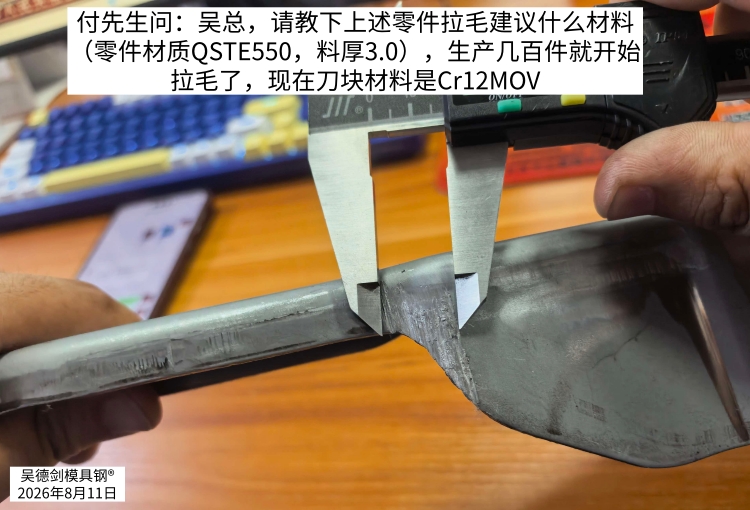
QSTE550 is a low-carbon, micro-alloyed, hot-rolled, pickled automotive structural steel with a thickness of 3 mm. When bending thick steel plates like this, the die is prone to sticking, which can cause surface scratches and scuffs on the product. You’re using the wrong material with Cr12MoV—it won’t last long, and even a coating won’t help. You’ll have to switch materials.
Cr12MoV is a high-carbon, high-chromium cold-work tool steel with a carbon (C) content of 1.5% and and 12% chromium (Cr). After heat treatment, its microstructure contains microcracks. Furthermore, since Cr12MoV is extremely inexpensive and of very poor metallurgical quality, it suffers from severe microstructural segregation and numerous microcracks. When used in bending or stretching dies like this, it is extremely prone to causing surface scratches. The fact that scratches began appearing after only a few hundred parts were produced further confirms this—it is simply the wrong material.
This also reminds me of a client who manufactures stretch dies for casters—the products are extremely similar. He originally used Cr12MoV, and it also developed scratches after producing just over a hundred pieces. The owner reported that when stretching 1.1mm-thick Q195 cold-rolled sheet metal for casters, Cr12MoV without a coating was simply unusable; scratches would appear before even 100 products were produced. The 8503 we purchased last time has produced about 30,000 products; while it does experience some material sticking that causes scratches, it performs much better than Cr12MoV.

Mr. Fu asked: When forming and bending 3mm-thick QSTE550 material, after producing a few hundred parts with a Cr12MoV die, the parts started to become rough. What type of die steel should be used?
I recommend using 8503 die steel, which resists material adhesion. 8503 is a non-stick die steel exclusive to Wudejian Die Steel. It has twice the toughness of DC53 and a hardness of 59–61 HRC. Compared to DC53, its performance is doubled without a corresponding increase in price, and it offers the added benefit of being non-stick. This non-stick property is particularly advantageous for drawing dies, as it helps prevent stringing on the product.
*************
Wu Dejian’s tool steel, the chief of staff of the user, bought everything he had used.