Today I met with three clients who left a strong impression on me—two came to our office in person, and one called for a consultation. I get the sense that mold steel users like to treat themselves like guinea pigs: they buy the medicine themselves, brew it themselves, and take it themselves; if it doesn’t work, they switch to a different medicine and keep trying.
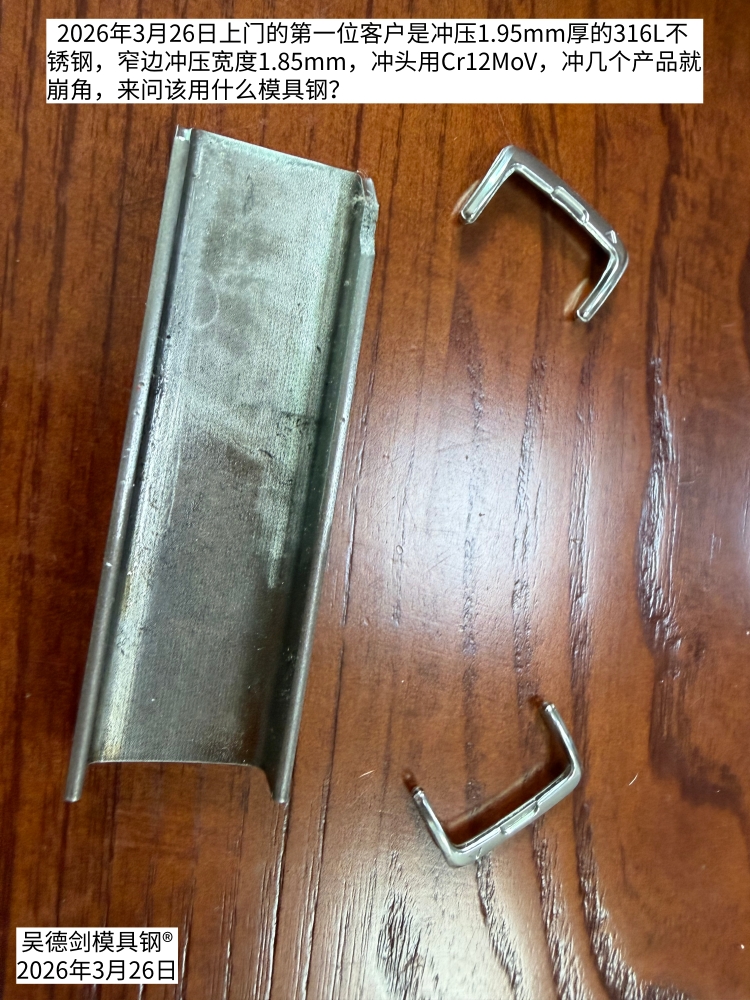
The first client is from Liaobu Town. He brought his die and product with him and came directly to our company. He’s stamping 316 stainless steel watch bands using the 2.0 process. A 1.8mm narrow-edge punch keeps chipping—the punch width is less than the sheet thickness, and the stamping ratio is less than 1:1. The mold steel he’s currently using is prone to punch chipping; he’s tried Cr12MoV, D2, SKD11, and DC53, but after producing just a few hundred pieces, the narrow edge of the punch chips off. Unable to find a solution and having watched my videos frequently—plus seeing that I was relatively close by (we’re both in Liaobu Town, Dongguan City)—he brought his product to me.
Just look at it: he’s tried so many different types of mold steel, buying the steel himself, making the dies himself, using them once they’re done, and switching to another type when they don’t work well. It’s like using himself as a guinea pig—buying the medicine himself, brewing it himself, taking it himself, and switching to another remedy when it doesn’t work.
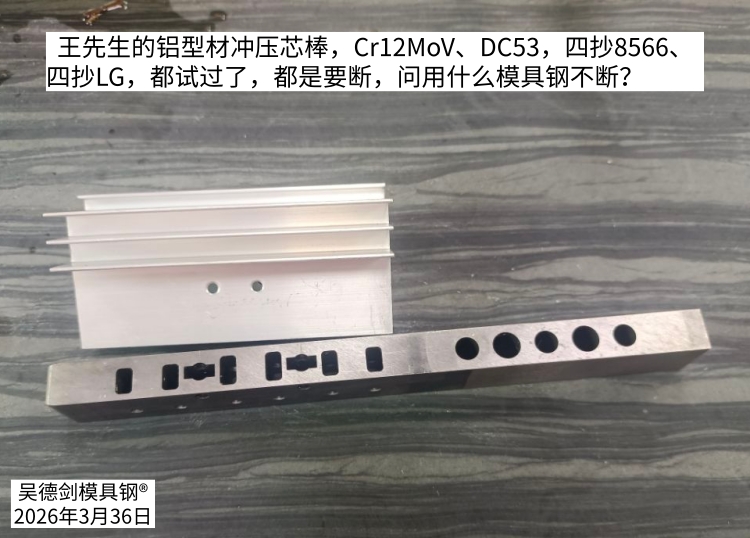
The second customer had a single-arm cantilevered mandrel for an aluminum profile punching die. The mandrel was designed to extend into the tube for side punching. It was relatively small with minimal flange support, had low strength, and was required to punch a large number of holes, resulting in uneven stress distribution. We’ve already tried spring steel, H13, SKD61, Cr12MoV, DC53, Fake LG and Fake 8566—but in every case, cracks appeared after producing only a small number of parts. Unable to find a solution, they turned to our company and asked what tool steel to use for the mandrel so it wouldn’t break.
Look at this—it’s yet another case of treating oneself like a guinea pig: buying the mold steel yourself, making the die yourself, using it once it’s done, and switching to another type when it doesn’t work. Isn’t this exactly like treating yourself as a guinea pig—buying the medicine yourself, brewing it yourself, taking it yourself, and if it doesn’t work, trying another one, and only turning to others for help when all else fails?
There’s also a third customer who produces stamped brass inserts made of 62 copper and 65 copper, with a thickness of 1.5 mm. He has a punch that chips after producing only a few parts, making it impossible to complete the job in half a day. He had already tried DC53, SKH-9, ASP60, Fake 8566, and Fake LG, but they all chipped easily, and he couldn’t find a solution. After he contacted me, I still recommended that he use 8566 anti-chipping steel. We already have a successful track record with copper inserts.

Our client, Mr. An, said that when stamping 1.5-thick copper inserts, the original mold steel was prone to chipping at the corners, tended to accumulate copper powder, and left scratches along the cutting edge, resulting in subpar precision stamping. In contrast, 8566 die steel performed flawlessly after 300,000 stamping cycles. Even when we presented him with such a concrete example, he remained skeptical.
Now he’s heard from others that H13 and SKD61 might work, so he wants to buy some to try them out.
Just think about it—he’s already tried 5 or 6 different materials, and none of them worked. He buys the mold steel himself, makes the dies himself, and uses them himself; if they don’t work, he just switches to another one. Now that he’s come to me, I’ve already recommended 8566 chipping-resistant steel and provided a concrete case study, but he still isn’t convinced and wants to give H13 and SKD61 another try.
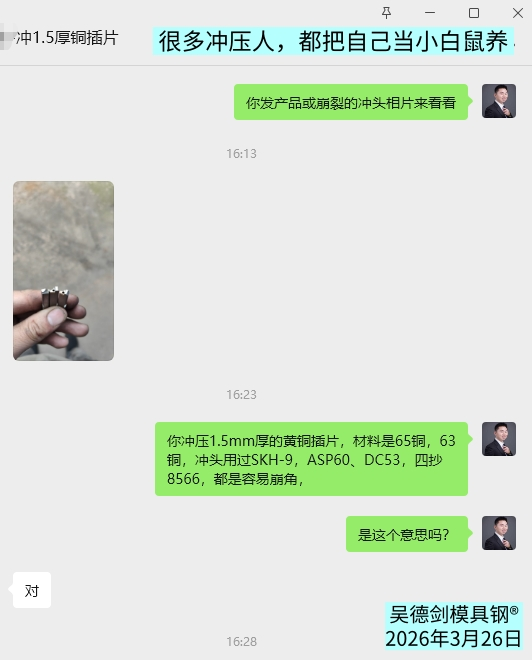
We mold steel users all like to treat ourselves like guinea pigs, always thinking we’re so clever. Making molds costs nothing—we buy our own equipment and do it ourselves. Mold steel isn’t expensive anyway; if it doesn’t work out, we’ll just switch to another type. Just look at him—he’s done exactly that. He’s used SKH-9 at a few hundred per kilogram, ASP60 at several hundred per kilogram, Fake 8566, and Fake LG—and now he’s getting ready to try H13 and SKD61.
From these three inquiries today, I get the sense that our customers aren’t actually making molds—they’re conducting experiments, treating themselves like lab rats. They buy the mold steel themselves, make the molds themselves, and when one doesn’t work out, they just switch to another. After all, they’re bound to find a suitable one eventually; if all else fails, they’ll ask someone else for advice. Once they hear about a material they haven’t tried yet, they’ll give it another go.
This isn’t production—it’s pure experimentation. If everyone operates this way, we’ll never achieve high efficiency, long service life, and low-cost use in our production.
Of course! If you trust me—if your mold materials aren’t performing well, you can’t find a solution, or you’re undecided—then you can come to me.
*************************
I’m Wu Dejian, the “Mold Steel King,” from Dongguan Yuhui Mold Steel. Yuhui Mold Steel is used by three Fortune 500 companies and seven of China’s Top 500 companies. Kyocera has been sourcing Yuhui Mold Steel for seven consecutive years. I’ve helped over 4,000 companies solve complex problems related to mold material selection, manufacturing, and usage. If you’re unsure about which mold steel to choose, or if the mold steel you’re currently using results in short mold lifespans and you don’t know which material to use, feel free to reach out to me. I’m confident that when it comes to mold material selection and application, I can serve as your chief advisor and help you avoid costly trial-and-error. Wu Dejian Mold Steel—the users’ trusted advisor. Everyone who’s tried it is satisfied!