Mold steel is a type of tool steel, which is divided into seven categories: carbon tool steel, low-alloy tool steel, high alloy tool steel (also known as cold work mold steel), high-speed tool steel, plastic mold steel, hot work mold steel, and special purpose steel. Different molds require different properties, and there are approximately 750 steel grades for mold steel.
The alloy composition and properties of some steel grades may seem the same, but the performance of mold steel is determined by the comprehensive effects of alloy composition, smelting quality, internal structure, heat treatment process, and microstructure, rather than a single one-to-one causal relationship; It is not enough to ensure the performance of mold steel just by meeting the alloy composition standards. Although the performance specifications written in the manual are similar, the smelting quality of each steel mill is different for the same steel grade, and the performance of mold steel is also different. The heat treatment process of each pre hardening plant is different, and the performance of mold steel produced by different heat treatment plants for the same steel grade in the same steel plant is also different.

This is also the reason why many people feel confused when choosing mold steel, as they all feel similar about which one to choose. At the same time, this is also the reason why many businesses mix good and bad. They bully users into not understanding and use alloy composition standards to promote themselves as “national standard materials”, with cheap prices and high cost-effectiveness to embellish themselves.
However, after purchasing and using the product, customers find that its performance does not live up to the specifications in the manual. Unable to identify the cause, they are left with no choice but to accept the loss in silence. In reality, the manufacturers have misrepresented the facts by presenting five factors as if they were individual, one-to-one elements. This is precisely why the mold steel market is flooded with counterfeit products, substandard goods, and shoddy workmanship.
The 750 steel grades can be broadly categorized into seven major groups, each with distinct alloy compositions, properties, and applications.
Carbon tool steel refers to tool steel with a very high carbon (C) content and relatively high hardness, but without any alloying elements. Common grades include T8, T9, T10, and T12. The “T” is the Chinese pinyin abbreviation for carbon, and the number following it represents the carbon content in percent; T8 indicates a carbon content of 0.8%, while T12 indicates a carbon content of 1.2%.
These steels typically achieve a high hardness of 55–60 HRC and offer better wear resistance than cast iron. However, because they contain no alloying elements, they have poor hardenability, resulting in inconsistent hardness between the surface and core. They are also brittle and prone to fracturing, making them unsuitable for precision wire-cutting machining after heat treatment. They are generally used for guide pins and bushings, as well as simple tools, in applications that require only wear resistance and are not subject to impact, but they are inexpensive.
To improve the hardenability and wear resistance of tool steel, a small amount of alloy is added to the steel, resulting in low-alloy tool steel. The amount of alloy added is minimal, generally 1% to 2%, so the improvement in performance is limited. Common grades include GCr15 (rolling bearing steel), 60Si2Mn (spring steel), 9CrWMn (oil steel), 9SiCr, and W2.
During quenching, the alloy elements and carbon form certain hard carbide structures, thereby improving wear resistance and increasing hardenability. The hardened layer becomes deeper, allowing the tool to be repaired multiple times without compromising the cutting edge’s wear resistance. Since the hardness becomes more uniform, impact toughness is also enhanced. The typical service hardness is 55–60 HRC. These steels are suitable for simple molds, wear-resistant components such as bearings and springs, and hand tools operating at low cutting speeds, including paper cutters, sewing needles, woodworking tools, and kitchen knives.
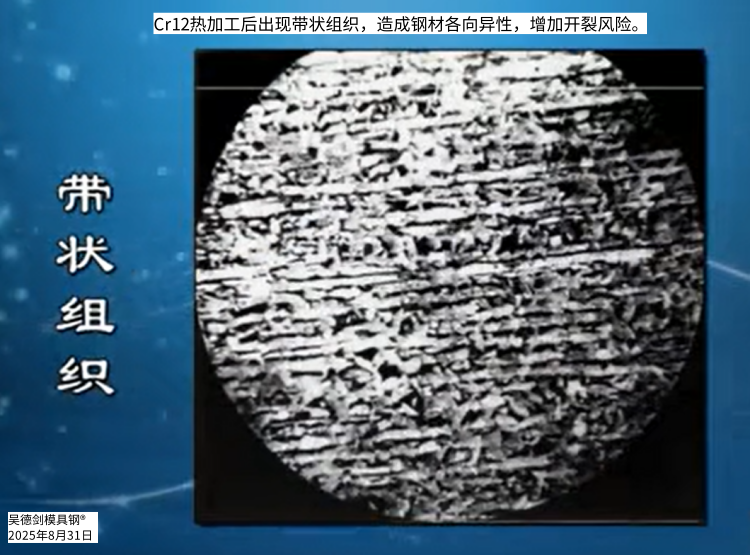
To further improve wear resistance and the depth of the hardened layer, a large amount of alloying elements is added to the metal. For example, Cr12 contains 2.0% carbon and 12% chromium to enhance its hardenability and produce a large amount of hard carbide structure, thereby improving wear resistance. This is high-alloy tool steel, commonly referred to as cold-work tool steel. Its wear resistance is approximately three times that of low-alloy tool steel. Due to its uniform hardness and high tempering temperature, internal stresses are significantly released, improving toughness. After heat treatment, it can undergo precision wire-cutting machining without cracking and is widely used in molds and automated parts requiring high cutting speeds.
Common grades of cold work die steel include Cr12, Cr12MoV, SKD11, Cr12Mo1V1, D2, DC53, 8503, 8566, LD, 88, K340, among others. With a hardness of HRC 58–62, these steels offer excellent wear resistance while maintaining good resistance to chipping. Their stability is significantly improved, expanding their range of applications to include even harsh operating conditions. Due to their wide range of applications, these grades are frequently mentioned and are well-known to us.
To further enhance wear resistance and meet the demands of high-speed cutting, hard material machining, and other applications with special wear resistance requirements, high-speed tool steels were developed. These steels contain 20%–30% total alloy content and incorporate significant amounts of tungsten-cobalt alloys, which offer excellent red hardness. With a hardness range of HRC 62–69, they not only exhibit superior wear resistance but also maintain exceptional red hardness. Under high-heat conditions generated by high-speed cutting, their hardness does not decrease, allowing them to sustain high levels of wear resistance and cutting performance—a characteristic not found in other tool steels.
A typical grade is W18Cr4V. Although this is a tungsten-based high-speed steel, its excessively high tungsten (W) content results in significant brittleness and substantial resource waste. Researchers then conceived the idea of replacing tungsten (W) with molybdenum (Mo) to enhance toughness while maintaining red hardness. This led to the development of the tungsten-molybdenum-based general-purpose high-speed steel W6Mo5Cr4V2, which operates at a hardness of HRC 62–64 and features significantly improved impact toughness. Additionally, the difficulties associated with smelting and heat treatment have been greatly reduced, and the production process has been optimized. This material has become a standard in the high-speed steel category, featuring widespread application, high market demand, and a long history. It has been in use for 120 years and has yet to be phased out by the market.
Common grades of high-speed steel include W6Mo5Cr4V2, SKH51, SKH-9, M2, SKH55, M35, SKH-59, and M42. They are primarily used in high-speed cutting tools, hard-material cutting tools, and mold punch materials requiring wear resistance.

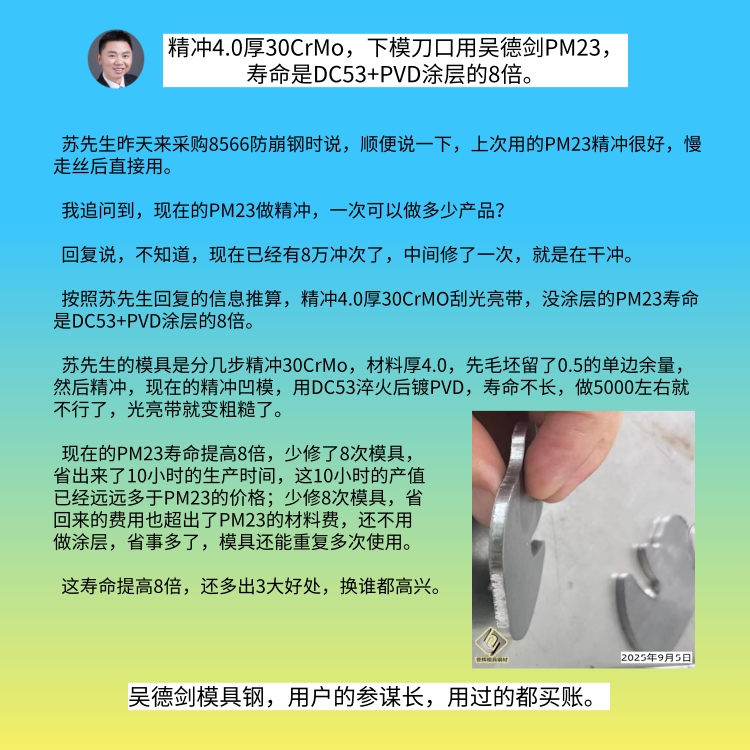
Due to current production demands, higher requirements have been placed on wear resistance and fracture resistance. the total alloy content of conventional cast high-speed steel could no longer be increased. Consequently, advanced powder metallurgy processes were adopted, which further increased the total alloy content and carbon (C) content of high-speed steel. This altered the morphology of carbides, increasing their quantity and reducing their size while ensuring a more uniform distribution. As a result, wear resistance was significantly improved while maintaining impact toughness, leading to a substantial extension of the service life of cutting tools and molds.
Common grades of powder-metallurgy high-speed steel include PM23, PM4, PM30, PM53, and PM60, while well-known brand names include ASP23, ASP30, and ASP60.
Powdered high-speed steel has been in existence for 55 years. Thanks to continuous technological advancements, particle sizes have become increasingly fine and performance has improved significantly, leading to its widespread adoption. However, high smelting costs have limited its use. Nevertheless, from a performance perspective, it is fully capable of replacing conventional cast high-speed steel.
Plastic mold steel is primarily used in injection molds. Depending on the nature of the application, it is generally divided into three categories: pre-hardened plastic mold steel, rust-resistant plastic mold steel, and high-hardness plastic mold steel.
Pre-hardened plastic mold steel is supplied by steel mills with the hardness already tempered, allowing it to be machined directly into molds. This saves mold manufacturers the cost and time associated with heat treatment, making it suitable for large-scale molds. The hardness typically ranges from 28 to 42 HRC. Common grades include P20, 2311, 2738H, 718H, NAK80, and FDAC. In the stainless steel series, common grades include S136H, 2316H, 4Cr13H, and 2083H.
Rust-resistant plastic mold steels evolved from stainless steels and generally refer to martensitic stainless steels that can be quenched and hardened. These molds are rust-resistant, corrosion-resistant, and capable of mirror polishing. In addition to the pre-hardened stainless steels mentioned above, there are grades that require quenching and hardening for use in hard molds. Common grades include 4Cr13, 2Cr13, 3Cr13, 2083, S136, S136-D, M316, 2316, and M340, with a quenched hardness of HRC 50–56.
High-hardness plastic mold steels are supplied by steel mills in an annealed condition. After rough machining, they are quenched and tempered for use as hard molds, typically with a hardness of 50–60 HRC. In addition to the stainless steels mentioned above, other grades include H13, 2344, SKD61, 8407, 8418, LG, and 8503.
Hot-work die steels refer to materials used for die-casting, hot-forging, and hot-extrusion dies that operate at high temperatures. These steels require heat treatment and typically contain a high proportion of heat-resistant alloys such as molybdenum (Mo). They offer excellent heat resistance, thermal fatigue resistance, erosion resistance, and thermal wear resistance, along with high red hardness and superior high-temperature strength. Different dies and applications require distinct performance characteristics.
Common grades of hot-work die steel include the low-alloy 5CrNiMo, the tungsten-based 3Cr2W8V, and chromium-based hot-work die steels that combine the toughness of low-alloy steels with the heat resistance of tungsten-based steels while also offering erosion resistance. Common grades include 4Cr5MoSiV, 4Cr5MoSiV1, H13, H11, SKD61, 2344, 8407, and 2343. These four categories are the most common hot-work die steels on the market and are frequently used in our daily operations.
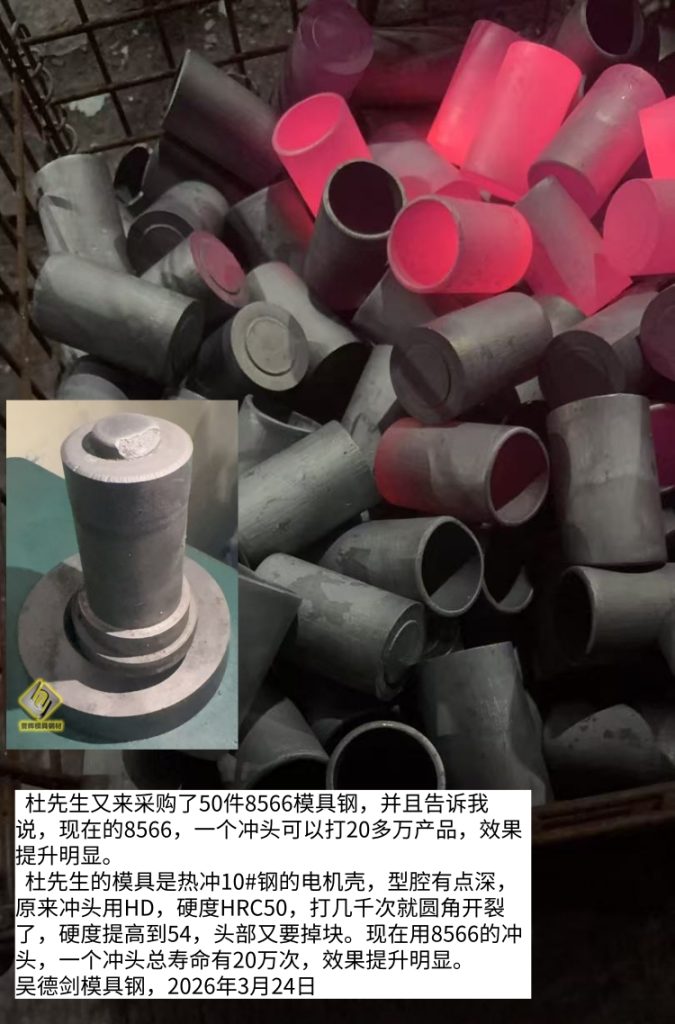
There are also steels with superior heat resistance, such as 8418, DIEVAR, HD, and 8433. Additionally, there are chromium-molybdenum-tungsten-based hot-work die steels with hardness ranging from HRC 54 to 60 and better thermal wear resistance, including GR, W360, LG, 8566, and YXR33.
Special-purpose steels generally refer to customized steel grades designed for specific applications. Since we do not encounter them frequently, we will not elaborate further here.
The introduction to mold steel provided above is a classification based on performance characteristics, designed to aid in memorization. There are no clear boundaries or rigid rules regarding the classification of mold steel; these categories are simply intended to facilitate its use by users. They are also a summary of my own industry experience gained from many years of working with mold steel. I hope this serves as a useful reference for understanding, selecting, and using mold steel.
***********
I am Wu Dejian, the “King of Mold Steel,” from Dongguan Yuhui Mold Steel. Yuhui Mold Steel is used by three Fortune 500 companies, and Kyocera has been sourcing our products for seven consecutive years. I have helped over 4,000 companies solve complex challenges related to mold material selection, manufacturing, and usage. If you’re unsure about which mold steel to choose, or if the steel you’re currently using results in short mold lifespans, and you’re unsure which material to use, feel free to reach out to me. I’m confident I can serve as your trusted advisor in this area and help you avoid costly mistakes. Wu Dejian Mold Steel—your trusted advisor—and customers who’ve tried us keep coming back!