8566 anti-cracking steel is not only widely copied in the mold industry, but also in the cutting tool industry. (8566 die steel)
The day before yesterday, while on a business trip, I received a call from Mr. Lin on the highway. Mr. Lin is a cutting tool user who operates a wood chipper in Huaiyang. The blades on his chipper are no longer durable—low-hardness cutting edges wear out easily, while high-hardness steels like DC53 and Cr12MoV are prone to chipping, resulting in a short blade life. He contacted many manufacturers of wood chipper blades, and they all recommended 8566 chipping-resistant steel, which offers high hardness and good toughness.
However, after researching extensively online, he discovered that 8566 chipping-resistant steel is a proprietary product of Yuhui. So he asked these blade manufacturers, and every single one told him they were using Yuhui’s 8566, shipped from Guangdong, with prices varying widely. He felt very uneasy about this. To put his mind at ease, he kept searching online until he found my video. He then called me to ask if there were any blade manufacturers who had purchased my 8566 to make these blades—so he could simply buy the 8566 blades from that manufacturer.
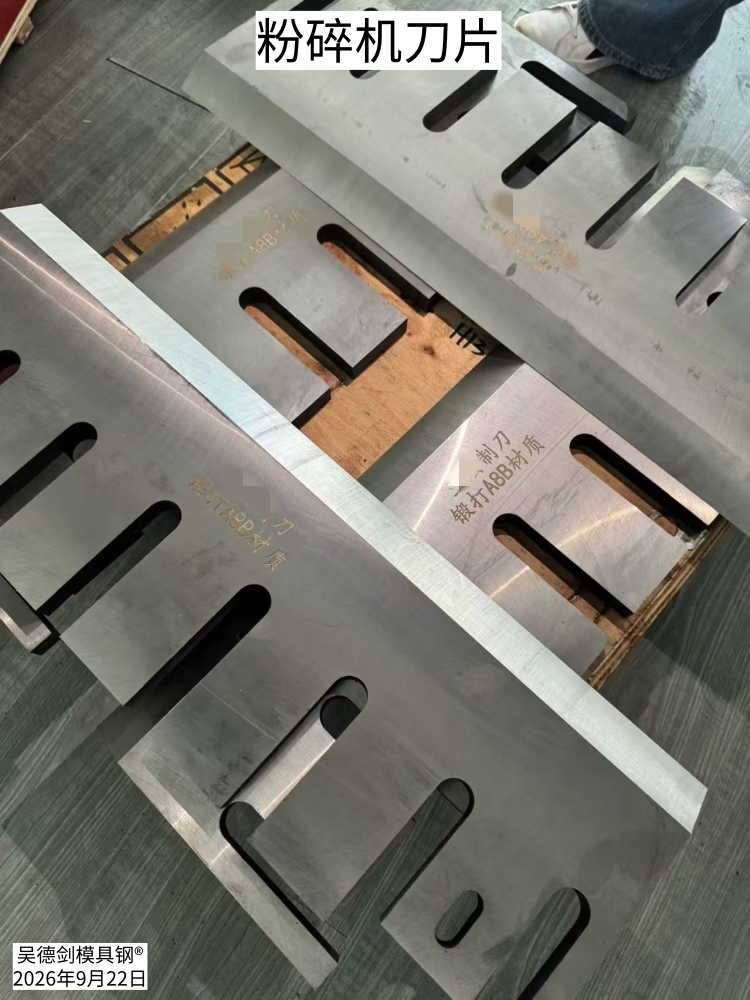
As a customer, spending money isn’t the issue; the biggest fear is buying blades that don’t perform well—wasting money on something that doesn’t work. That’s the most heartbreaking part. After receiving this message, I felt quite disheartened. I never expected that 8566 chipping-resistant steel—which used to be copied and counterfeited only in the mold industry—would now be facing chipping issues in our tooling and cutting tool industries as well, requiring the use of 8566 chipping-resistant steel, and that it’s already being copied.
The materials used for these shredder blades are generally very inexpensive. Inferior blades are made from 45 steel, with the cutting edge subjected to high-frequency quenching. The advantage is that they’re cheap, but the cutting edge lacks sharpness. Slightly better quality blades use H13, with a hardness of 50–54 HRC; it offers better wear resistance than 45 steel while maintaining toughness. For higher hardness, manufacturers might use Cr12MoV or DC53; while these meet the hardness requirements, they are prone to chipping and are not practical. The ideal blade material combines high hardness with good toughness, ensuring a sharp cutting edge without chipping.
The chipping resistance of 8566 anti-chipping steel is four times that of SKH-9 high-speed steel and twice that of D2, with a hardness of 58–60 HRC. It is primarily designed to address the chipping issues that high-hardness die steels such as D2, DC53, and SKH-9 cannot resolve. The properties of 8566 make it highly suitable for crusher blades, offering both high hardness and excellent chipping resistance—though the price is too high. As things stand, people have been consulting me about this for several years, but so far, no blade manufacturer has actually put it into practice.

Based on Mr. Lin’s concerns and his inquiry, I’ve identified a business opportunity. The objective need to address blade chipping exists, and 8566’s superior chip resistance makes it well-suited for blade applications. Customers have this pain point, and since our product offers this performance, this application scenario represents a new field of application for 8566—and a new market demand.
It’s true that every industry is highly competitive these days, but everyone is striving to move up the value chain. Users want blades with excellent performance and a long service life—not cheap blades that chip easily. If you produce the same products as every other blade manufacturer, you won’t be competitive, and you won’t hold any standing with customers. I hope that in the future, a blade manufacturer will be willing to take the first step—using 8566 chipping-resistant steel to help your customers solve blade chipping and sharpness issues—and claim the first slice of the market.
Using 8566 die steel for punch chipping—it’s like night and day compared to the old ways.
*************************
Wu Dejian’s tool steel, the chief of staff of the user, bought everything he had used.