I. Introduction to the Issue: Why Does It Take 3–4 Hours to Saw a Large Die Steel Plate?
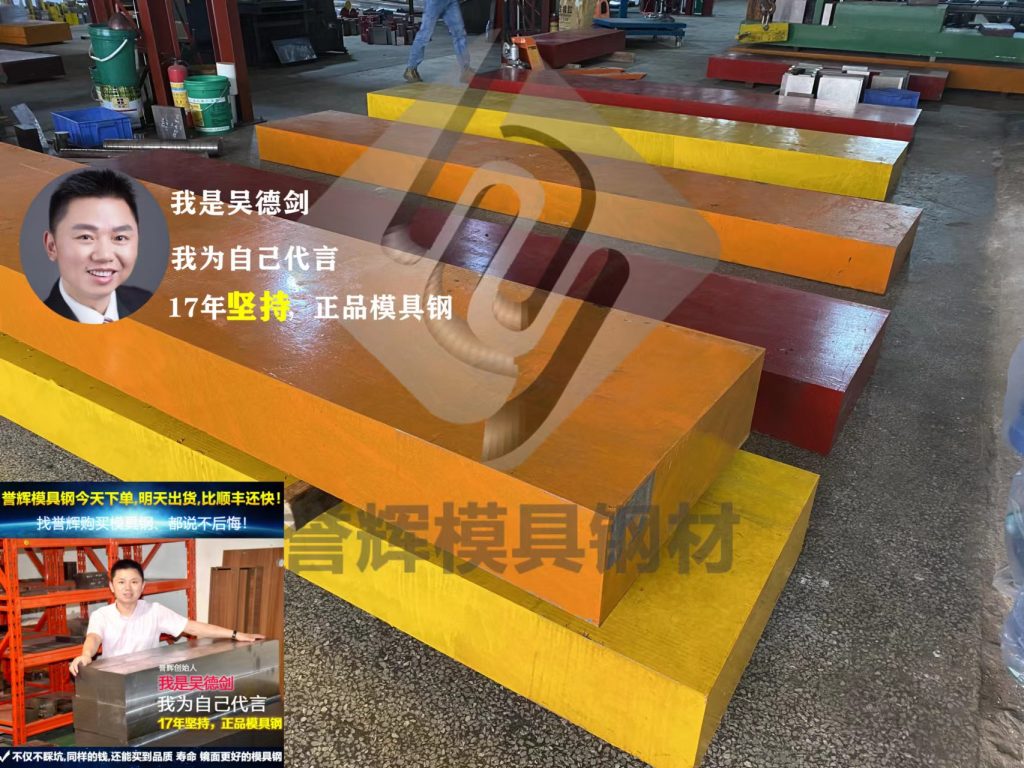
We have just completed a major project: sawing a thick die steel plate measuring 700 mm wide by 430 mm high, with each cut taking 3–4 hours.
Why go to such great lengths to cut it? There is only one purpose: to ensure the smelting process of six-side forging and “Three forging, Three stretching”. This time, the customer placed an order for four large pieces measuring 700mm × 430mm, and each one must be processed exactly according to the promised specifications.
II. Industry Reality: Fraud in Mold Steel—It’s No Longer Just About Alloy Composition, but About Origin and Smelting Processes
III. Conclusion First: When buying mold steel today, the biggest pitfalls aren’t in the alloy composition, but in the origin and smelting processes.
1) Composition: Alloy composition is almost impossible to fake anymore (spectral analysis can verify it);
2) Origin Fraud: They claim the material comes from a major manufacturer, but actually supply material from a small one;
3) Process Fraud: They promise six-sided forging or “Three forging, Three stretching” but actually supply machine-rolled material*—this is the most easily overlooked and hardest to detect by conventional means.
The Fraudsters’ Profit Logic: They attract customers with low prices but cut costs by passing off machine-rolled material as forged material. While the price appears low, their profits remain intact. Meanwhile, competitors who insist on using genuine, high-quality materials end up appearing “expensive.”
IV. Core Knowledge: Why Are Six-Side Forging and the “Three forging, Three stretching” Process Indispensable?
Forging is the third of the “Five Major Strengthening” processes for tool steel and directly determines the uniformity of the steel’s microstructure.
After a steel ingot is smelted, two inherent problems exist:
1) Alloy segregation: Uneven distribution of alloying elements;
2) Coarse grain structure: Large blocks of eutectic carbides impair toughness.
The only solution is six-side forging and the “Three forging, Three stretching” process:
| Process operation | Use |
| Three forging, Three stretching | Enable long-distance migration of grains to eliminate segregation. |
| Crushing of eutectic carbides | Eliminate the detrimental effects of large carbides on toughness |
| High-temperature diffusion + homogenization treatment | Homogenization of macro-and micro-grain microstructures |
Microstructural uniformity is a prerequisite for performance: only when the microstructure is uniform can the steel’s “designed properties” be realized.
Consequential logic: Why does forging fail, and why can’t heat treatment salvage it?
Heat treatment is the fifth and final process among the five major strengthening methods, responsible for bringing out the designed properties. However, it “brings out” these properties—it does not “alter” them:
The microstructure of die steel is continuous. If the microstructure lacks uniformity and features coarse grains, no matter how meticulously heat treatment is performed, the grains will remain coarse, the microstructure will remain poor, and the final performance will still fail to meet specifications.
Therefore, forging (the third strengthening process) lays the foundation for the effectiveness of heat treatment (the fifth strengthening process)—skipping six-sided forging means that all subsequent processes are simply wasted effort on a poor foundation.

V. Our Approach: Integrity and Diligence—No Compromises in Any Step of the Process
1) We have specifically equipped our facility with a Taiwanese Heji sawing machine for cutting large, thick plates;
2) Sawing such large materials is labor-intensive, consumes saw blades, and wastes material, but it is essential to ensure performance;
3) Few in our industry have this level of patience and commitment—and this is precisely the cost dividing line between true craftsmanship and machine-rolled steel.
VI. Conclusion
The mold steel industry is mired in a price war, but in the end, what truly sets us apart is integrity in craftsmanship. Once alloy compositions can no longer be faked, the origin and smelting process become the only areas open to fraud. When selecting mold steel, don’t just look at the grade and price on the quote sheet; ask this crucial question: Is this material truly produced through six-sided forging and a “Three forging, Three stretching” process?
In the mold steel business, only by maintaining integrity and diligence in every step of the process can performance be guaranteed and stabilized—and only then will customers continue to place orders.
*************
Wu Dejian’s tool steel, the chief of staff of the user, bought everything he had used.