The first customer who came today is stamping 316L stainless steel with a thickness of 1.95mm. The narrow edge punch width is 1.85mm, and the punch is made of Cr12MoV. After punching a few products, the corners will collapse, and production cannot be carried out. He came to ask what kind of Tool steel should be used?
This customer is in Liaobu, Dongguan. We are in the same town and very close to each other. He often watches my videos and now the problem of the punch cracking cannot be solved. So he came to me with the product and punch directly for a face-to-face meeting.
The width of the punch is 1.85mm, which is smaller than the plate thickness of 1.95mm. This is because the stamping ratio is less than 1:1, and the punch is more prone to corner breakage. It is also a harsh working condition for stamping 316L, a relatively hard stainless steel with narrow edges, which requires extremely high anti cracking and wear resistance of the Tool steel. It is normal for the punch to easily crack.
In addition, he uses Cr12MoV, a high carbon steel with a carbon C content of 1.5%. With the current Cr12MoV being extremely low in price and poor in smelting quality, it is inevitable that it will crack easily. He is currently stamping several products, and dozens of them will collapse, which also illustrates this point.
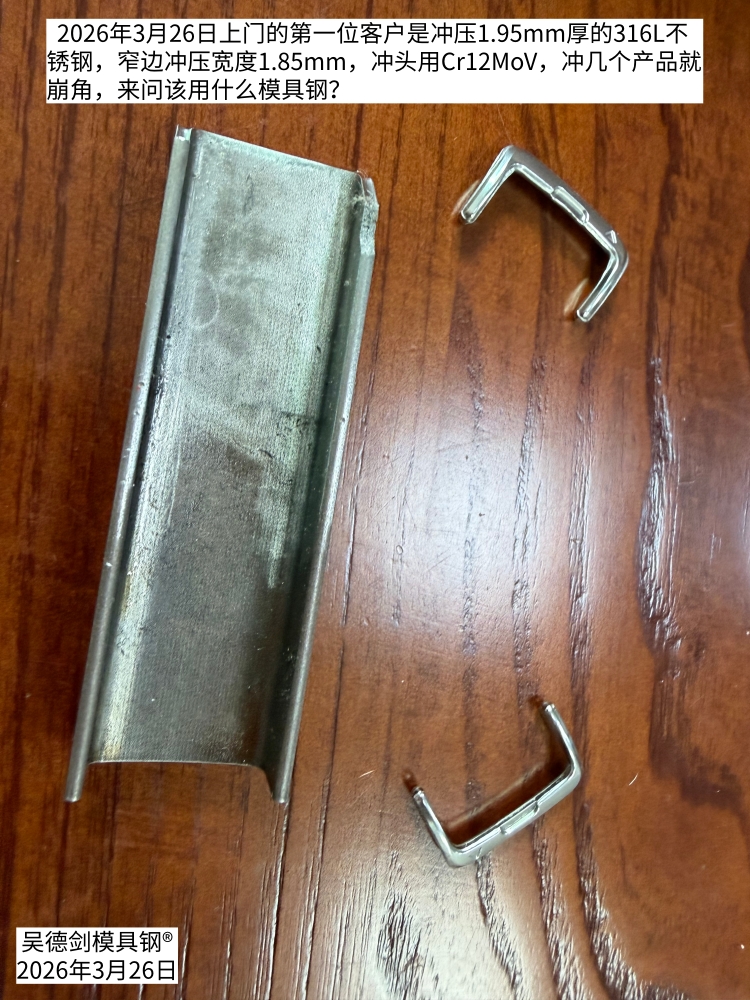
The cruel working condition where the punch width is less than the plate thickness and the stamping ratio is less than 1:1, choosing Cr12MoV was originally a mistake, and it cannot be saved. The only option is to change the material to 8566 die steel.
8566 is a proprietary anti collapse steel developed by Yuhui Tool Steel, which mainly solves the problem of mold cracking; It has accumulated over a thousand cases in 5 working conditions, 6 major materials, and 7 major fields of stamping.
The anti cracking performance of 8566 is four times that of high-speed steel SKH-9 and twice that of D2, with a hardness of 58-60HRC. It can solve the cracking problem that high hardness tool steels such as D2, DC53, and SKH-9 cannot solve; Especially in harsh working conditions such as stainless steel stamping, sharp corner stamping, narrow edge stamping, stamping aperture smaller than plate thickness, and stamping ratio less than 1:1, the cracking that cannot be solved by conventional tool steel is solved by using 8566 anti collapse steel.
His punch doesn’t use a lot of materials, and we have small hard materials in stock for our 8566 anti collapse steel. So I asked him to choose a suitable size first, go back and try it out, and we will make adjustments based on the situation after use.
But I believe that using 8566 die steel for punch cracking can solve the problem of punch cracking in both old and new societies.
*******
Wu Dejian tool Steel is the user’s chief of staff and everyone who has used it buys it.