Over the past couple of days, I’ve received two inquiries regarding the punching of stainless steel over 2 mm thick, where the punches tend to chip. I’ve found that in both cases, the wrong tool steel was used. In one instance, the customer was punching 2.0 mm thick, hard 304 stainless steel; the SKH-9 punch broke after just a few hundred pieces. The other case involved stamping 2.3mm-thick 316 stainless steel with a material hardness of 300 HV. Both DC53 and SKH-9 punches chipped after just a few trial runs, making production impossible. I’d like to take this opportunity to discuss which diel steel is best for punching stainless steel over 2mm thick.
It all started when Mr. Fu asked for advice: he was stamping 304 stainless steel—a very hard material—with a thickness of 2.0 mm, and wanted to know what die steel would work best for the punch. Currently, he’s using SKH-9, which breaks easily at the flange, failing after just a few hundred products.

Seeing this product—which is supposedly made of very hard 2.0mm-thick stainless steel—reminds me of the stamping and cold heading process for ice crusher blades, which use 2mm-thick 304 stainless steel. Cold-headed stainless steel is extremely hard, and since the product has many small, sharp corners and narrow edges that extend far out, it’s prone to chipping. Materials like DC53, SKH-9, and PM23 are all prone to chipping at the corners, making production impossible.
However, for the past three years, we’ve been using 8566 anti-chipping steel to prevent punch chipping, allowing production to run smoothly. As the boss puts it, it’s all thanks to 8566 holding up the main load.

Mr. Fu’s blank material is 2.0 mm thick, made of hard 304 stainless steel, and features sharp corners. Given that it is a hard material, a thick plate, and has sharp corners—combining multiple adverse conditions—the requirements for resistance to chipping are extremely high. SKH-9 is prone to chipping and fracturing, so 8566 anti-chipping die steel must be used.
SKH-9 is a high-speed tool steel with a carbon (C) content of 1.0%, 6.0% tungsten (W), and a hardness of 62–64 HRC. Its high carbon, high alloy, and high hardness content give it excellent wear resistance and red hardness. However, its hardness also makes it brittle. Its wear resistance comes at the expense of toughness. When used for punching thick, hard materials with sharp corners, chipping is to be expected—and could even be considered a mistake in material selection.
However, 8566 die steel offers four times the crack resistance of SKH-9 high-speed steel and twice that of D2, with a hardness of 58–60 HRC—a unique characteristic of this material. It resolves the cracking issues that high-hardness die steels such as D2, DC53, and SKH-9 cannot address. Particularly under harsh conditions—such as stainless steel stamping, stamping of thick, hard materials, sharp-corner stamping, narrow-flange stamping, or even when the hole diameter is smaller than the sheet thickness and the stamping ratio is less than 1:1—8566 die steel effectively resolves die chipping issues and significantly extends die life.
Mr. Xia used 8566 anti-chipping steel for a progressive die to fine-punch 2mm-thick stainless steel. The fine-punching die required a fully polished strip, with a small punching clearance and high cutting force, making the punch head prone to chipping. Given the 2mm thickness and the presence of sharp corners, the working conditions were similar to Mr. Fu’s. However, Mr. Xia’s fine-punching die, made with 8566 anti-chipping steel, achieved 40,000 punches—doubling its service life without any corner chipping. It’s like night and day compared to the old days!

Mr. Fu is punching 2.0mm-thick 304 stainless steel, which is very hard. The SKH-9 he’s currently using breaks after punching just a few hundred parts. This requires improving the die steel’s resistance to chipping, taking into account the performance requirements of the molding conditions, the properties of 8566 anti-chipping steel, and Mr. Xia’s application experience. I recommend using 8566 anti-chipping steel. Switching to 8566 die steel for the punch will make a world of difference.

Another question comes from Mr. Ma: When stamping 316 stainless steel with a hardness of 300 HV and a thickness of 2.3 mm, punches made of DC53 and SKH-9 tend to break—some break in the middle, others chip at the edges. They break after just a few trial runs. What type of die steel should be used?
Mr. Ma’s operating conditions are even more severe: the material is both 2.3 mm thick and has a hardness of 300 HV. During the stamping process, this material generates significant vibration, making the punch head and shank particularly susceptible to breaking due to vibration. Furthermore, his punches feature a narrow-flanged C-shaped design with thin walls and insufficient strength, making them even more prone to breaking under vibration.
However, he chose two types of hard and brittle high-carbon steels: SKH-9 high-speed steel, which was discussed earlier and has even poorer crack resistance than DC53. DC53 is also a material with 1.0% carbon content and a composition of Cr8Mo2VSi, with a hardness of 60–62 HRC. As a high-carbon, high-hardness material with a high proportion of secondary hardening phases, it offers excellent hardness and strength. However, this strength is achieved at the expense of toughness, making it very brittle. The fact that the punch broke after just a few test strikes confirms this, clearly indicating a mistake in material selection.

Furthermore, in today’s mold steel market, price competition is fierce. To compete on price, steel mills are deliberately cutting back on certain processes to reduce smelting costs and achieve lower prices. However, these process cuts lead to even more severe segregation in high-carbon steel, This disrupts the continuity of the base material, further compromising the steel’s impact toughness. As a result, the already limited impact toughness of DC53 and SKH-9 is further diminished. When used for stamping thick plates, hard materials, or narrow flanges, the punches are much more prone to chipping.
Therefore, using SKH-9 high-speed steel to punch hard stainless steel materials thicker than 2 mm will inevitably result in punch chipping—a situation that can be attributed to incorrect material selection.
However, with the increasing volume of stainless steel stampings, stainless steel is becoming harder to ensure part strength. At the same time, customers are demanding lower burr levels, leading to tighter die clearances to minimize burrs. This places even higher demands on the die steel’s resistance to chipping.

In response to genuine market demand, Yuhui Mold Steel has launched a proprietary anti-spalling steel, 8566, designed specifically to address mold spalling issues. It has accumulated over a thousand case studies across five stamping operating conditions, six major material types, and seven key industries.
In terms of alloy composition, 8566 avoids high carbon content, thereby improving spalling resistance at the source. 8566 is an exclusive product of Yuhui Mold Steel.
In terms of smelting technology, Yuhui’s 8566 anti-spalling steel is produced using a critical gas electroslag furnace, which reduces five major harmful impurities and enhances purity. This ensures the integrity of the base material is maintained, providing greater assurance of spalling resistance. Additionally, a 4,500-ton press is used for six-sided forging with a three-forge, three-drawing process. This significantly improves microstructural segregation, eliminates internal nodules, enhances crack resistance, and modifies carbide morphology to ensure wear resistance. Post-forging, a 4-day, 5-night pre-heat treatment is applied to refine the grain structure, improve machinability, and prepare the microstructure for subsequent quenching.
For the final heat treatment, we employ our proprietary and well-established Wu’s Process, which involves dedicated furnace processing, vacuum heat treatment, and proprietary technical treatments to fully unlock the chipping resistance and high strength of 8566 anti-chipping steel.
The reason 8566 exhibits chipping resistance four times that of SKH-9 high-speed steel and twice that of D2 is due to the combined effects of its proprietary alloy composition, high-quality smelting processes, and proprietary heat treatment techniques. This results in exceptionally high chipping resistance while maintaining a hardness of 58–60 HRC and high strength, making it highly suitable for demanding applications such as stainless steel stamping, sharp-corner punches, and narrow-edge stamping.
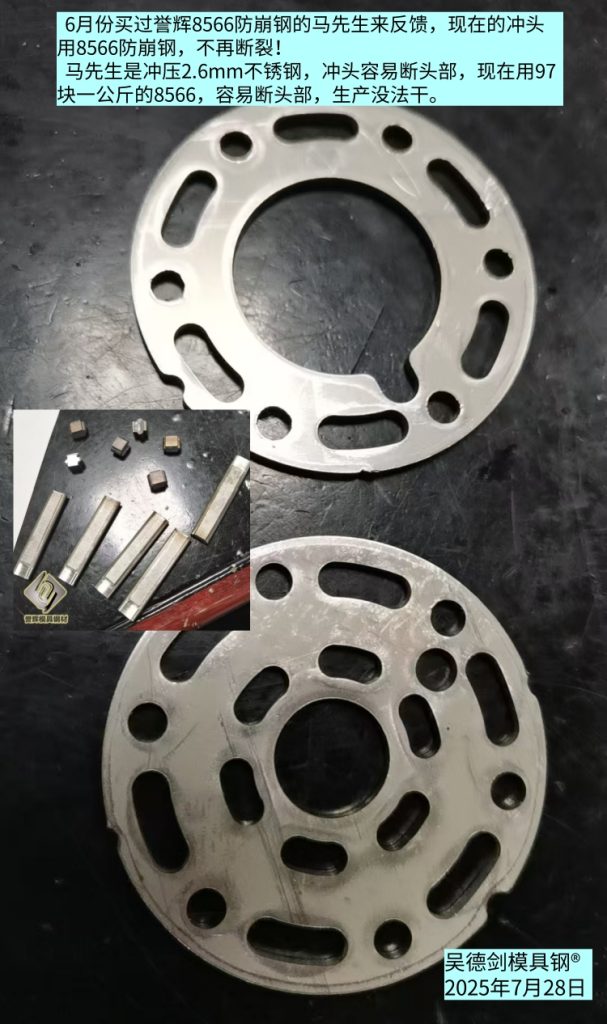
Mr. Ma was stamping 2.6mm-thick stainless steel floor drain products, which feature numerous thin-walled, waist-shaped holes. He had previously purchased 8566 steel at 97 yuan per kilogram, but the punches would break immediately upon use, making production impossible. However, after switching to Yuhui 8566 anti-chipping steel, Mr. Ma reported that the punches no longer break, and he has received no further complaints from customers.

Mr. Cheng also noted that using 8566 anti-chipping steel for stamping stainless steel is indeed effective. When punching 3.0mm-thick stainless steel with a punch made of 8566 anti-chipping steel, it can withstand 30,000 punches without any issues.
This 30,000-cycle performance stands in stark contrast to Mr. Fu’s punches, which break after just a few hundred cycles, and Mr. Ma’s trial punches, which chip after only a few strikes—the difference is truly enormous. It would not be an exaggeration to describe this as a world of difference between the old and the new.
Therefore, when Mr. Fu punches 304 stainless steel—a very hard material with a thickness of 2.0 mm—using SKH-9 punches, they are prone to breaking, often failing after just a few hundred products. Mr. Ma, on the other hand, is stamping 2.3mm-thick 316 stainless steel with a hardness of 300 HV. With DC53 or SKH-9 punches, his trial runs would break after just a few shots. You should all be using 8566 anti-chipping steel for your die punches. Using 8566 die steel for punches prevents chipping—it’s like night and day compared to the old methods—and it will save you a lot of trouble.
*************
I am Wu Dejian, the “King of Mold Steel,” from Dongguan Yuhui Mold Steel. Yuhui Mold Steel is used by three Fortune 500 companies, and Kyocera has been sourcing our products for seven consecutive years. I have helped over 4,000 companies solve complex challenges related to mold material selection, manufacturing, and usage. If you’re unsure about which mold steel to choose, or if the steel you’re currently using results in short mold lifespans, or if you’re unsure which material to use, feel free to reach out to me. I’m confident I can serve as your trusted advisor in this area and help you avoid costly mistakes. Wu Dejian Mold Steel—your trusted advisor—and customers who’ve tried us keep coming back!