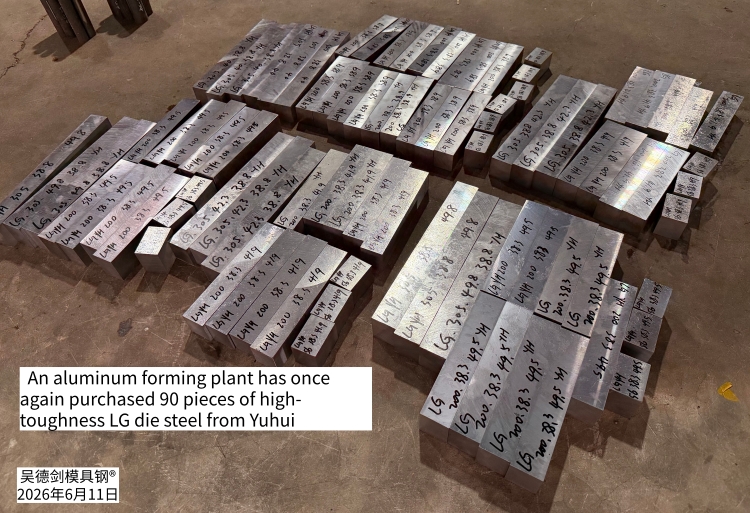
I saw these 90 pieces of machined, high-toughness LG die steel blanks in the workshop, ready for shipment. I’m in a good mood, so I wanted to share this with everyone.
This customer manufactures cold-extruded, shaped, and bent aluminum products. Previously, they used Cr12MoV and SKD11, both of which were prone to sticking to aluminum shavings, resulting in scratches on the products. Since these are cosmetic parts with extremely strict appearance requirements, any scratches render the products scrap—and given the high volume of production, this was a major issue. The scratches caused by Cr12MoV and SKD11 were a persistent problem he’d struggled with for a long time.
He had considered coating or laminating the Cr12MoV, but none of these methods worked; the tools still adhered to aluminum shavings, causing scratches on the products, and the problem remained unsolved. However, three years ago, he began using Yuhui’s high-toughness LG die steel, which resolved this issue. As a result, he now frequently places bulk orders; this time, he purchased 90 pieces, and this is just one of his many orders.
The fact that the customer is able to make frequent, large-volume purchases demonstrates his recognition of LG’s performance and quality. LG has solved the problem of scratches in his aluminum forming dies.
Just recently, another customer—who uses 6061 aluminum forming dies—encountered issues where H13 die plates would collapse, resulting in products with improper dimensions and appearance. Using DC53, on the other hand, led to frequent mold cracking. Even after reducing the hardness to 52–54 HRC, the mold life remained unstable—sometimes lasting 10,000 to 20,000 cycles, other times cracking after just a few thousand cycles. He asked me what the cause might be.
Aluminum is very soft and tends to penetrate the mold, especially at the fillet corners, where it can seep in and eventually cause the mold to split. DC53 is a high-carbon steel with a carbon content of 1.0%. High-carbon steels tend to have a very fine grain structure, containing numerous microscopic cracks invisible to the naked eye. When aluminum powder is encountered during the forming and extrusion process, aluminum debris adheres to the mold. This not only causes surface scratches on the product but also allows aluminum debris to seep into the R-corners. As the debris accumulates, it eventually causes the mold to split.
Many people mistakenly believe that mold cracking is solely due to poor toughness and that reducing hardness will solve the problem. They lower the hardness of DC53 from 60–62 HRC to 52–54 HRC, thinking this will improve toughness. In reality, this does nothing to extend the mold’s service life; it is merely a psychological placebo. The fact that their molds sometimes crack after just a few thousand cycles, and other times after 10,000 to 20,000 cycles, demonstrates this inconsistency in service life. With H13, the strength is too low, causing the mold to deform and resulting in products with non-conforming dimensions after trimming. This indicates that for his molds, toughness should be the top priority, followed by strength; such molds are better suited for high-toughness LG die steel.
LG mold steel has 8–9 times the toughness of DC53, with a hardness of 54–58 HRC. Its toughness is so high that it won’t break even if you bend it with a hammer. If your aluminum profile forming dies, bending dies, or cold extrusion dies are experiencing issues such as aluminum swarf sticking, product scratches, or poor toughness leading to breakage—or if you’re using other die steels with short service life—you should also try high-toughness LG die steel.
*************
Wu Dejian’s tool steel, the chief of staff of the user, bought everything he had used.