Today, let’s talk about a topic related to die steel. When it comes to bending or drawing dies, avoid using Cr12MoV whenever possible.
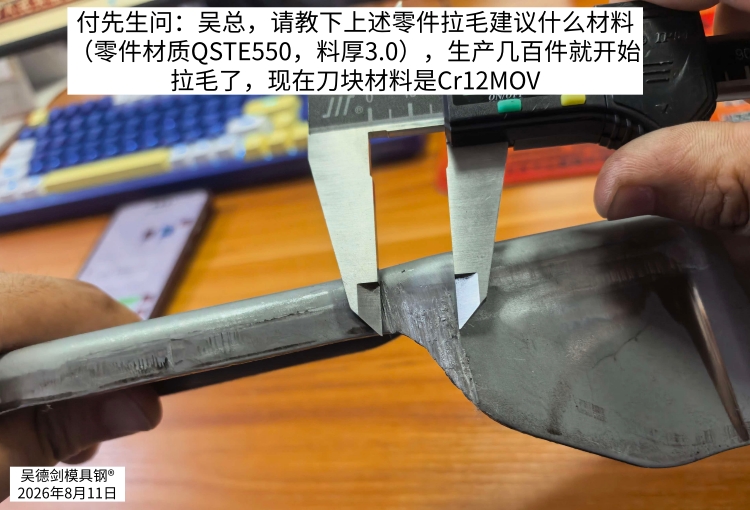
Between yesterday and today, I’ve received two similar inquiries. The first was from Mr. Song, who asked me: “The bent parts tend to get scratched. What die steel should I use? The material being bent is SQTE550, 3.0 thick. I’m currently using Cr12MoV, but after making just a few hundred products, the bent areas get scratched. What die steel should I use for the die?”
The second case involved 1.5-thick pickled sheet metal with a drawing height of 10 mm. The four corners of the square profile were made of Cr12MoV. After producing 100–200 parts, the four corners became rough and started sticking to the material. The buildup of material kept getting worse and worse. Unable to find a solution, they cut off the four corners and inlaid them with tungsten carbide, but the roughness still occurred after producing only a few more parts. He couldn’t understand why this was happening. YG20 cemented carbide has a hardness of 86–89 HRA, which is already very high, so why was material still sticking so easily?
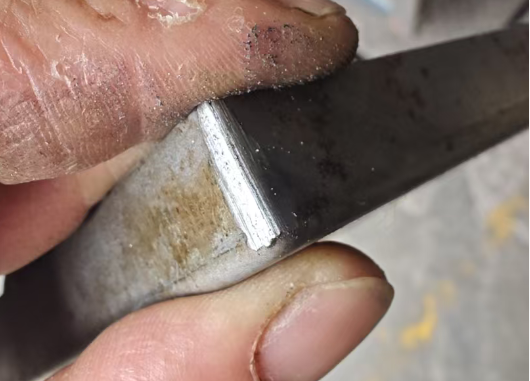
This mold sticking issue has nothing to do with hardness; it’s related to the metallurgical quality of your mold steel. Whether your mold steel has segregation or microscopic cracks is the fundamental cause of the sticking.
Cr12MoV is a high-carbon, high-chromium cold-work die steel with 1.5% carbon and 12% chromium. Its microstructure already contains microcracks after heat treatment. Furthermore, since Cr12MoV is currently extremely cheap, the smelting quality is very poor, segregation is severe, and there are even more microcracks, making it more prone to material sticking and stringing. They now experience mold sticking and stringing after producing just a few hundred products—the reason being the extremely poor smelting quality of Cr12MoV.

We have a customer who produces drawn casters from 1.1-thick Q195 steel, with a drawing height of 50–60 mm. He said that Cr12MoV simply cannot be used without a coating; after producing just over 100 products, stringing occurs. However, when using non-stick 8503, stringing only begins to appear after producing 30,000 products, and the mold can be reused after polishing. The performance of non-stick 8503 for draw dies is far superior to that of Cr12MoV.
Yes, 8503 has a hardness of 59–61 HRC and twice the toughness of DC53. Compared to DC53, its performance doubles without doubling the price, and it offers the added benefit of being non-stick—a feature that’s especially beneficial for drawing or bending dies.
If you’re currently using Cr12MoV, D2, SKD11, or DC53 for your steel bending or drawing dies and are experiencing rapid material sticking and wire-drawing marks, and you’re unsure which die steel to use, then the non-stick 8503 die steel is definitely worth a try.
As a reminder at the end of the video: for drawing or bending dies, if you can avoid using Cr12MoV, try to avoid it as much as possible—the risk of failure is very high. Once a problem arises, the losses extend far beyond the cost of the Cr12MoV material itself—they also include heat treatment costs, mold machining costs, labor costs, and wasted time. These losses are substantial. Rather than risking this, it’s better to invest in higher-quality mold steel to resolve the issue once and for all.
*************
Wu Dejian’s tool steel, the chief of staff of the user, bought everything he had used.